What Is CNC Machining in EV Manufacturing?
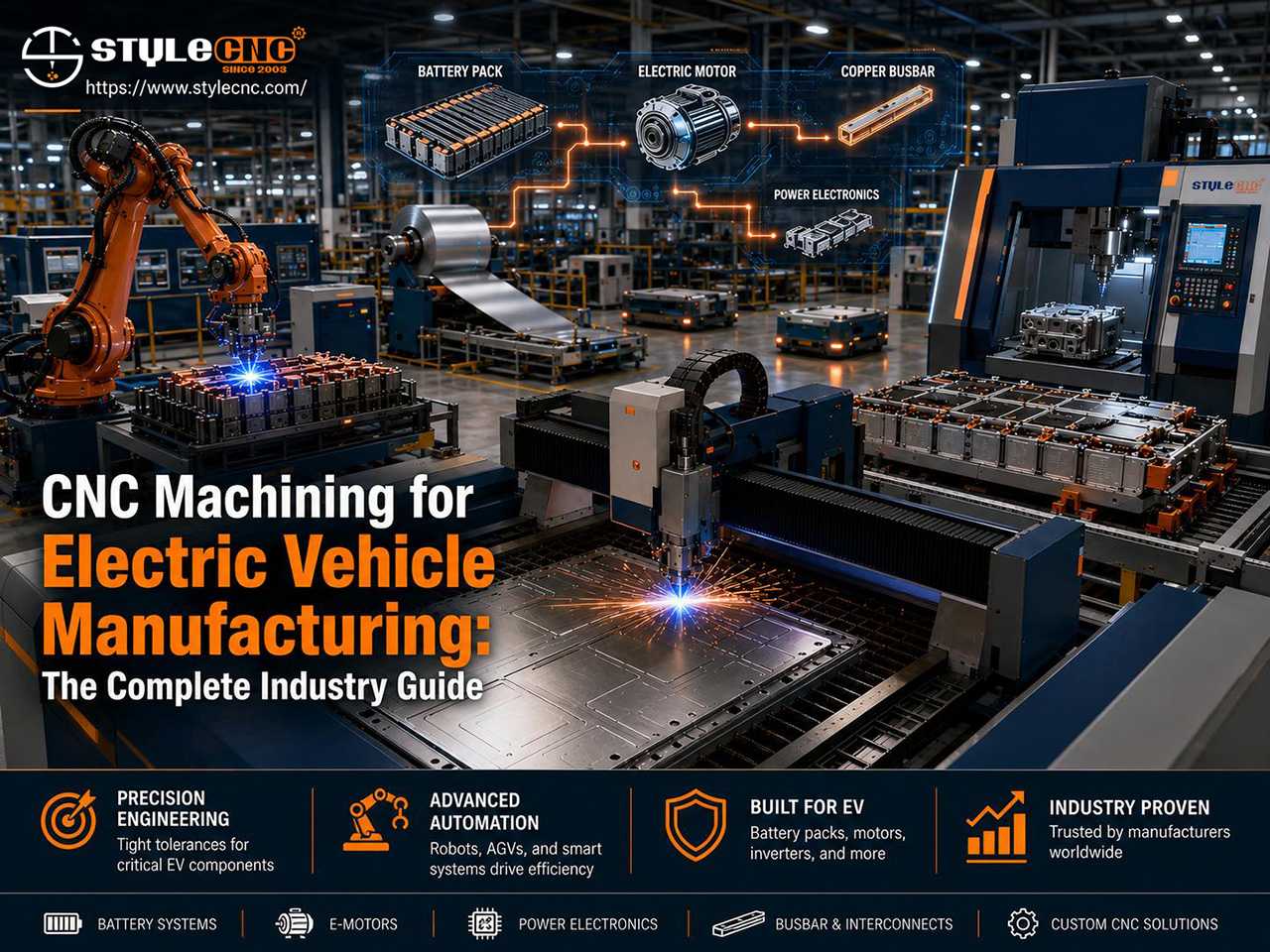
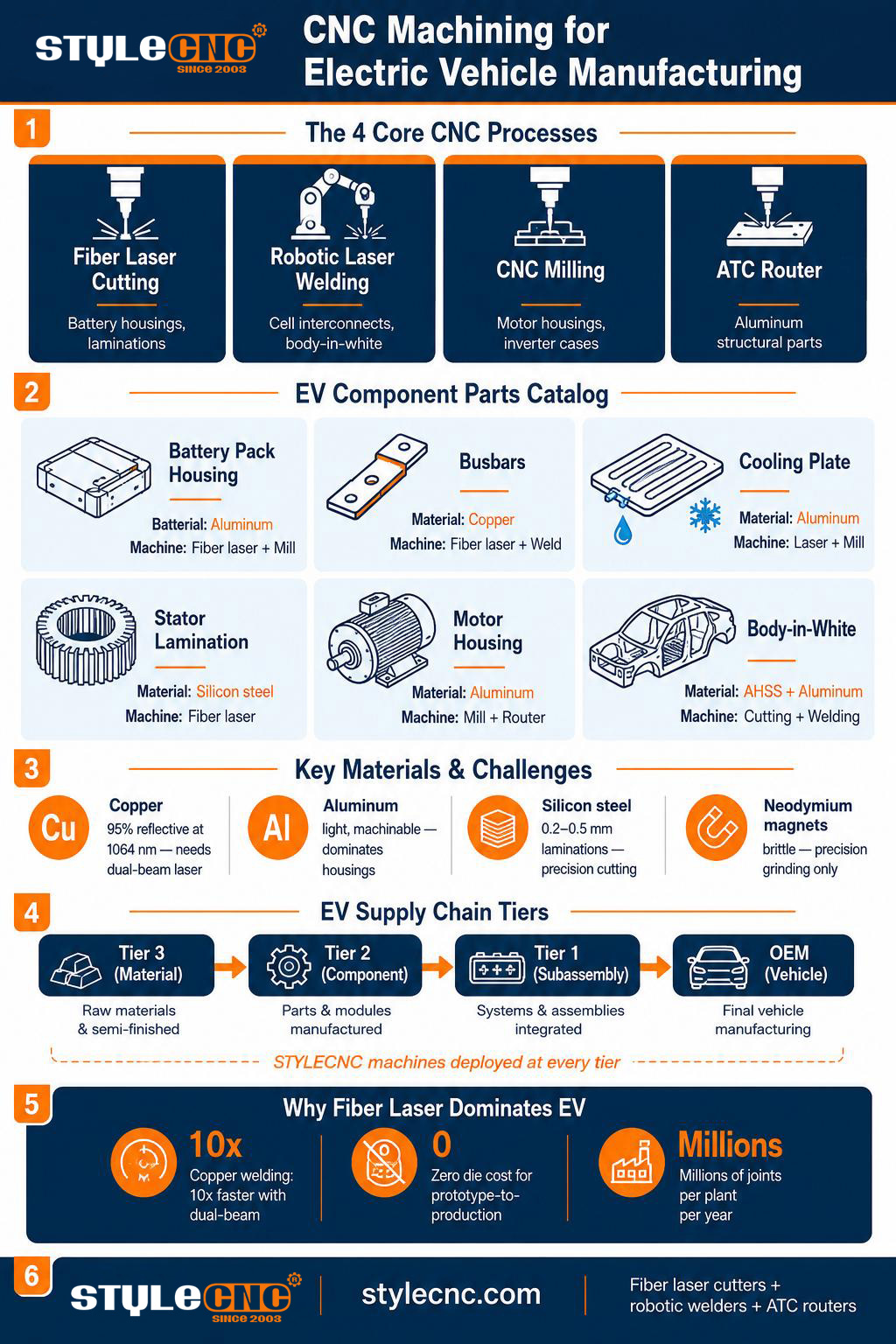
The primary CNC machines used in EV manufacturing are fiber laser cutters for battery housings and body panels, robotic laser welders for cell interconnects and busbars, precision CNC mills for motor components and inverter housings, and ATC routers for aluminum structural parts. Each process handles specific materials and part geometries within the EV supply chain.
EV manufacturing sits at the intersection of automotive volume and aerospace-grade precision. A single battery pack contains thousands of individual welded connections. A single motor requires precision-cut silicon steel laminations, aluminum housings machined to tight tolerances, and copper windings that must be joined without heat damage.
The result is a manufacturing environment where CNC machinery is deployed at every stage: raw material blanking, component fabrication, subassembly welding, final housing machining, and finished product marking. Volumes range from prototype quantities in R&D to millions of parts per year in production. The mix of processes is different from traditional automotive because EVs replace the internal combustion engine and transmission with battery packs, electric motors, and power electronics, each demanding a different CNC toolset.
EV Component Parts Catalog: What Gets Machined and How
The table below maps the major EV components to the CNC machines that produce them. It is designed as a reference for buyers researching EV supply-chain machining.
| EV Component | Function | Material | CNC Process |
|---|---|---|---|
| Battery pack housing | Structural enclosure protecting cells | Aluminum 6061 or die-cast ADC12 | Fiber laser cutting + CNC milling |
| Battery module casing | Groups cells into modules | Aluminum sheet, 1 to 3 mm | Fiber laser cutting |
| Busbars | Current-carrying interconnects between cells | Copper or aluminum, 1 to 5 mm | Fiber laser cutting + laser welding |
| Cooling plates | Battery thermal management | Aluminum with brazed channels | Fiber laser cutting + CNC milling |
| Cell interconnects | Cell-to-busbar joining | Nickel-plated steel or copper tabs | Robotic laser welding |
| Motor stator laminations | Electromagnetic core stack | Silicon steel, 0.2 to 0.5 mm | Fiber laser cutting |
| Motor housing | Structural + thermal enclosure | Aluminum die-cast | CNC milling + ATC router |
| Motor rotor | Rotating magnetic core | Steel with rare earth magnets | Precision CNC milling |
| Inverter housing | Power electronics enclosure | Aluminum | Fiber laser cutting + CNC milling |
| Charging port assembly | External charging interface | Aluminum or engineering plastic | CNC milling + injection tooling |
| Body-in-white panels | Vehicle body structural parts | Aluminum sheet + advanced steels | Fiber laser cutting + robotic welding |
| Battery pack lid | Hermetic top cover for pack | Aluminum sheet, stamped or cut | Fiber laser cutting + welding |
A single EV requires roughly 20 to 40 distinct CNC-machined component families depending on architecture and trim level. Battery-centric parts dominate by volume. Motor and inverter parts dominate by precision requirement. Body-in-white dominates by capital investment in the machinery involved.
Battery Systems Manufacturing: Housings, Modules, and Busbars
Battery pack manufacturing is where EV production consumes the most CNC machinery. A Tesla Model Y battery pack, for example, uses aluminum busbars with single-sided plating on the welded surface, arranged across four modules of 4680 cylindrical cells in a 92s9p configuration. Each module contains 107 cells and represents dozens of laser-cut and laser-welded interfaces.
Pack Housings and Structural Enclosures
Pack housings are typically fabricated from aluminum sheet or die-cast aluminum. Cutting is dominated by fiber laser cutters because of the sheet thickness (1 to 5 mm) and the geometric complexity of ports, cooling channels, and mounting features. Post-cut machining on CNC mills adds thread-tapped mounting holes, sealing surfaces, and pressure port interfaces.
Busbar Fabrication and Welding
Busbars are the electrical highways of a battery pack. They are typically copper or aluminum, from 1 to 5 mm thick, and shaped to weave through the module architecture. Cutting is done by fiber laser cutters because the material is highly reflective and thin. Welding busbars to cell terminals is the single most demanding operation in EV manufacturing: it involves dissimilar materials (copper to aluminum, or nickel-plated steel to copper), tight geometric tolerances, and volumes measured in millions of joints per year per plant.
Cell Interconnects and Cooling
Cell-to-busbar interconnects require robotic laser welding with beam wobble techniques to overcome copper's high reflectivity at the standard 1064 nm fiber laser wavelength. Modern dual-beam fiber laser welders can operate up to ten times faster than single-beam predecessors on these joints. Cooling plates woven through the pack for thermal management use aluminum sheet with brazed or laser-welded channels.
Electric Motor and Powertrain Manufacturing
Electric motors in production EVs are dominated by permanent magnet synchronous motors (PMSM) and increasingly by axial flux designs. Both architectures depend heavily on precision CNC machining.
Stator Laminations and Housings
Stator laminations are cut from silicon steel sheet 0.2 to 0.5 mm thick. Precision fiber laser cutting has largely replaced stamping for prototypes and low-volume runs because it eliminates tooling cost and allows rapid design iteration. High-volume production still uses progressive dies, but even those depend on wire EDM and laser cutting for tool fabrication. Stator housings are typically aluminum die-cast bodies finish-machined on CNC mills for bearing bores, mounting surfaces, and coolant passages.
Motor Hairpin Welding
Hairpin motor windings, now standard in many EV drive units, use rectangular copper wire bent and welded into a continuous stator winding. The tip joints between hairpin ends are welded by robotic fiber laser systems, often thousands of joints per motor. Beam quality and joint geometry determine the electrical resistance of the motor, which directly affects vehicle range.
Inverter and Power Electronics Housings
Inverter housings hold the silicon carbide power modules that convert battery DC into three-phase AC for the motor. They are typically aluminum with integrated cooling passages, produced by fiber laser cutting of blanks followed by CNC milling of sealing surfaces, mounting pads, and cooling channel finishing.
Production volumes for motor components are lower than battery components but tolerances are tighter. A single hairpin winding motor can require between 2,000 and 5,000 individual laser weld joints. Any joint with elevated resistance shows up as heat loss over the motor's operating life, so quality inspection at production speed is critical.
Materials in EV CNC Manufacturing
EV manufacturing uses a distinctive material mix compared to traditional automotive. Aluminum dominates the structural side because of weight, copper dominates the electrical side because of conductivity, and specialty steels appear in motor cores and body structures.
| Material | Where Used | CNC Process | Special Considerations |
|---|---|---|---|
| Aluminum 6061 / 6082 | Battery housings, motor cases, inverter enclosures | Fiber laser cutting, CNC milling | Excellent machinability, low weight, high thermal conductivity |
| Die-cast ADC12 | Motor housings, battery pack lids | CNC milling, finish machining | Cast porosity requires slow cuts, sealing surfaces critical |
| Copper (C110, C102) | Busbars, motor windings, hairpins | Fiber laser cutting + welding | Highly reflective at 1064 nm, needs beam wobble or dual-beam laser |
| Silicon steel (electrical steel) | Stator and rotor laminations | Fiber laser cutting, wire EDM | Precision cuts required for stack alignment |
| Nickel-plated steel | Cell terminals, cell tabs | Robotic laser welding | Nickel plating prevents intermetallic compound formation |
| Stainless steel 304 / 316 | Coolant tubing, sensor housings | Fiber laser cutting, CNC milling | Corrosion resistance, good for exposed parts |
| Advanced high-strength steel | Body-in-white structural panels | Fiber laser cutting, robotic welding | Very high tensile strength, requires higher laser power |
| Neodymium magnets | Motor rotors (PMSM) | Precision grinding | Brittle, hard to machine, magnetized after cutting |
The dissimilar-material problem is the defining technical challenge of EV manufacturing. Copper to aluminum, iron to aluminum, and nickel-plated steel to copper joints all form brittle intermetallic compounds when welded with conventional single-beam lasers. Dual-beam fiber laser welding, ring-mode beam shaping, and quasi-continuous wave (QCW) laser welding are the industry-standard solutions.
Fiber Laser Cutting: The Backbone of EV Metal Fabrication
Fiber laser cutting is the workhorse process across EV manufacturing. It handles battery housings, module casings, busbars, stator laminations, cooling plates, inverter housings, and body-in-white panels. The STYLECNC fiber laser cutting machine catalog covers configurations from small-format prototype cutters to industrial production platforms for continuous supply-chain use.
For structural battery housings and large body panels, the high-power fiber laser metal cutting machine handles thicker aluminum and steel sheet in configurations that match automotive supply-chain volume. For high-volume flat-stock production, the coil-fed laser blanking line replaces traditional stamping presses for battery pack lids, cooling plates, and structural panels where die cost cannot amortize.
For complex 3D geometry in production body-in-white work, the 3D robotic fiber laser metal cutting machine delivers multi-axis reach on assembled subframes, structural nodes, and stamped hydroformed parts that flat-bed cutters cannot access.
Sheet-metal thickness in EV production ranges from 0.2 mm silicon steel laminations at the thin end to 8 mm structural aluminum at the thick end. A single fiber laser platform rarely covers this entire range efficiently, which is why most EV supply-chain shops run two or three fiber laser configurations tuned for different thickness bands.
Nesting software is essential at production scale. A modern battery pack lid or module casing program includes hundreds of small features per sheet, and cut-order optimization directly determines how many parts a shift produces. Every fiber laser cutter STYLECNC deploys ships with nesting-capable CAM as part of the standard configuration.
Robotic Laser Welding: Cell Interconnects and Body-in-White
Laser welding is the enabling process for EV battery pack assembly and increasingly for body-in-white production. Fiber laser welders handle the millions of cell-to-busbar joints in every battery plant, and robotic laser welders handle the multi-axis welds that hold structural body panels together. The industrial fiber laser welding robots for automobile manufacturing article details the deployment pattern in modern EV plants.
For battery cell manufacturing specifically, the laser cutting and welding systems for lithium-ion battery manufacturing reference covers integrated production line configurations that combine cell tab welding, busbar attachment, and pack sealing on a single line. The 3D industrial fiber laser welding robot is a common building block for body-in-white cells that need multi-axis path following.
For lower-volume prototype work and production repair, the automatic CNC laser welding machine provides the same precision as robotic systems in a smaller footprint appropriate to R&D shops and specialty EV assemblers.
STYLECNC in the EV Supply Chain: Prototype to Production
EV manufacturing is a multi-tier supply chain. Tier 1 suppliers deliver finished battery packs, motors, and inverters to OEMs. Tier 2 suppliers deliver housings, busbars, and stator laminations to Tier 1s. Tier 3 material suppliers deliver aluminum sheet, copper sheet, and silicon steel to Tier 2s. CNC machinery is deployed at every tier.
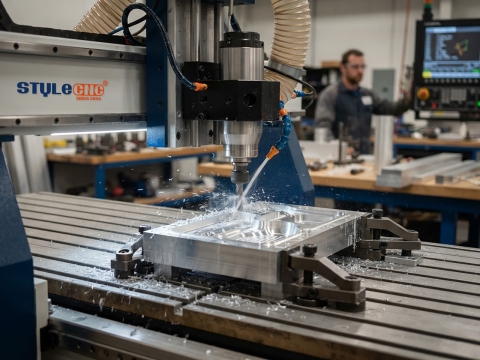
STYLECNC industrial machines are deployed across all tiers of the EV supply chain. Fiber laser cutters handle blank fabrication for battery housings at Tier 2 and Tier 3. Robotic laser welders handle cell tab welding and busbar joining at Tier 1 battery producers. ATC routers, including the aluminum CNC router with disk ATC system, handle structural aluminum machining for prototype and low-volume EV builds where die cost is prohibitive.
For prototype EV programs, the same fiber laser cutter that will eventually run production busbars can prototype the initial designs at the same accuracy. This continuity between prototype and production reduces the risk of design changes late in the program. It also cuts the number of separate suppliers a program manager must coordinate.
For production programs, STYLECNC coil-fed blanking lines, high-power fiber laser cutters, and 3D robotic welding systems are designed for the continuous-duty operation and integration with plant MES that EV manufacturing demands. Integration with customer-deployed sensor arrays, part traceability, and quality inspection is standard rather than optional.
Glossary: EV CNC Manufacturing Terms
Use this reference when comparing EV manufacturing processes, evaluating suppliers, or reviewing industry technical documentation.
| Term | Definition |
|---|---|
| Busbar | Rigid electrical conductor, typically copper or aluminum, connecting battery cells or modules. |
| Cell tab | Thin conductor extending from an individual battery cell for external connection. |
| Body-in-white (BIW) | Assembled vehicle body structure before painting or trim, dominated by welded steel and aluminum panels. |
| Hairpin winding | Motor winding style using rectangular copper wire bent into hairpin shapes and welded at the tips. |
| Silicon steel | Iron alloy with silicon added to reduce electrical losses; used in motor stator and rotor cores. |
| Wobble welding | Laser welding technique that oscillates the beam in a circular pattern to widen the melt pool. |
| Dual-beam laser | Fiber laser with two coaxial beams (core plus ring) for stable welding of reflective metals. |
| QCW laser | Quasi-continuous wave laser combining pulsed and continuous output for precision welding. |
| Intermetallic compound | Brittle metal-to-metal phase formed at dissimilar-material weld interfaces; must be controlled to prevent joint failure. |
| Coil-fed blanking | Sheet metal blanking process fed continuously from steel coil, used for high-volume automotive parts. |
Frequently Asked Questions
What CNC machines are used for EV manufacturing?
The core stack is fiber laser cutters for battery housings, module casings, busbars, and stator laminations; robotic laser welders for cell-to-busbar connections and body-in-white joints; CNC mills for motor housings, inverter enclosures, and rotor components; and ATC routers for aluminum structural parts. Every major EV OEM and Tier 1 supplier runs some combination of all four.
Why is laser welding so important in EV battery production?
Because battery joints must combine dissimilar materials at extremely low electrical resistance, thousands of times per pack, at production speeds. IPG Photonics and Tech Briefs industry coverage document that fiber laser welding with wobble or dual-beam techniques is the only technology that combines the speed, precision, and dissimilar-material capability required. Ultrasonic welding is used alongside for specific cell-to-tab connections but cannot replace laser welding for full-pack assembly.
What makes copper busbars difficult to weld?
Copper reflects roughly 95 percent of a standard 1064 nm fiber laser beam, causing unstable keyhole formation, spatter, and inconsistent penetration with single-beam systems. The industry solution is dual-beam fiber lasers where a ring beam pre-heats the copper to increase absorption, followed by a core beam that performs the actual weld. This eliminates spatter and delivers welding speeds up to ten times faster than single-beam predecessors.
How does EV manufacturing differ from traditional automotive machining?
Traditional automotive machining centers on the internal combustion engine, transmission, and chassis. EV manufacturing replaces those with battery packs, electric motors, and power electronics, which have completely different material and process demands. Copper welding becomes central. Silicon steel lamination cutting scales up. Aluminum structural machining increases sharply because EVs use more aluminum than ICE vehicles to offset battery weight.
What materials are hardest to machine in EV production?
Three material challenges dominate. Copper is hardest for laser processes because of reflectivity. Silicon steel is hardest for precision because lamination stacks must align micrometer-perfectly across thousands of layers. Neodymium magnets are hardest for machining because they are brittle, must be handled in specific orientations, and are usually magnetized only after cutting to avoid damaging cutting tools with residual magnetism.
Can existing CNC shops pivot to EV supply-chain work?
Yes, and many are. The equipment overlap is significant: any shop already running fiber laser cutters, robotic welders, or CNC machining centers has the core capability. What changes is programming, fixturing, and quality certification. EV supply chains typically require IATF 16949 automotive quality certification, part traceability, and MES integration. Machinery investment is often less of a barrier than the quality-system investment for shops entering the space.
The Bottom Line
EV manufacturing has changed the CNC industry as much as any single vertical in decades. Fiber laser cutting has become the default sheet-metal process. Robotic laser welding has moved from specialty to standard. Precision CNC machining of aluminum and copper components has grown sharply, and every tier of the EV supply chain now depends on CNC capability to hit cost and quality targets.
STYLECNC industrial fiber laser cutters, robotic laser welding systems, and ATC routers are deployed across EV supply chains globally, from prototype programs to Tier 1 battery pack producers. To discuss EV component machining configurations, review the fiber laser cutting machine catalog, the laser welding machine catalog, or contact the STYLECNC team for a configured quote against your specific part list.