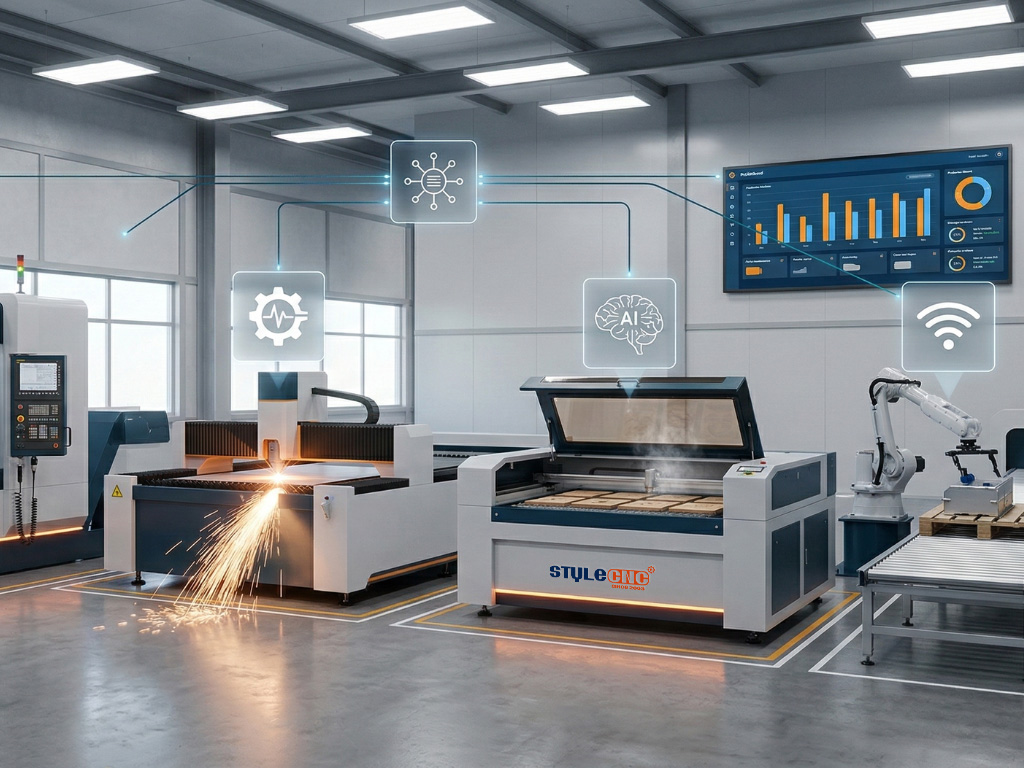
The CNC and laser industry is being reshaped by six converging forces: smart IoT-connected machines, AI-powered manufacturing, sustainability-driven production, the personalization economy, reshoring of production to North America and Europe, and electric vehicle manufacturing demand. The global CNC machine market exceeds $100 billion in value and is projected to grow at 5–7% CAGR as these trends accelerate across every manufacturing sector.
The CNC and Laser Industry at a Glance
The global CNC and laser equipment market is undergoing a fundamental transformation. No longer defined solely by cutting capacity and spindle speed, the industry is now driven by connectivity, intelligence, and sustainability. Multiple research firms value the global CNC machine market at over $100 billion, with consistent growth projections of 5–7% CAGR through the next decade. Asia-Pacific holds the largest regional share at 50–56%, while North America is the fastest-growing region, powered by reshoring initiatives and EV manufacturing expansion.
Global CNC Market Snapshot
| Metric | Value | Growth Rate | Source Consensus |
|---|---|---|---|
| Global CNC Market | $100–109B | 5–7% CAGR | Multiple firms |
| Asia-Pacific Share | 50–56% | 5.1% CAGR | Precedence / Fortune |
| North America | Fastest-growing | Reshoring + EV driven | Phoenix / Mordor |
| Automotive End-Use | 33–38% share | EV transition | Fortune / Coherent |
| Machine Tools Market | $90.88B | 8.9% CAGR to 2034 | Fortune BI |
| CNC Segment Share | 75.96% | Dominant segment | Fortune BI |
Key Market Growth Drivers
• Industrial Automation Expansion: Rising labor costs and precision requirements push manufacturers toward automated CNC and laser systems across every sector.
• Industry 4.0 Adoption: IoT sensors, cloud platforms, and digital twin technology are transforming traditional shops into data-driven production environments.
• Multi-Axis Demand Surge: Five-axis and above CNC configurations are growing at 10.8% CAGR as manufacturers consolidate operations into single-setup machining.
• Medical Device Growth: Medical CNC is expanding at 9.9% CAGR, driven by demand for sub-micron implants and FDA-compliant precision components.
• Defense and Aerospace: National security priorities and supply chain localization are accelerating CNC investment in aerospace-grade machining.
Trend 1: Smart CNC and IoT Integration
IoT-enabled CNC machines with WiFi connectivity, real-time performance monitoring, predictive maintenance alerts, and cloud dashboards are becoming standard in modern manufacturing facilities, reducing unplanned downtime by 30–50%.
The integration of Internet of Things technology into CNC and laser machines is one of the most immediately valuable shifts in the industry. Modern machines equipped with networked sensors transmit real-time data on spindle load, vibration, temperature, tool wear, and cycle times to centralized dashboards, giving operators full visibility into machine health from any device.
What IoT-Connected CNC Machines Can Do
• Monitor spindle load, bearing temperature, and vibration in real time.
• Send predictive maintenance alerts before component failure.
• Track cycle times, uptime, and OEE automatically.
• Enable remote diagnostics without on-site technicians.
• Connect multiple machines to a single cloud dashboard.
• Integrate with ERP and MES systems for automated scheduling.
Predictive Maintenance Impact
| Benefit | Improvement | Mechanism |
|---|---|---|
| Unplanned Downtime | 30–50% reduction | Alerts before failure |
| Component Lifespan | 15–25% extension | Usage-based replacement |
| Maintenance Costs | 20–30% reduction | Eliminates unnecessary service |
| Production Throughput | 10–20% increase | Less idle time between jobs |
Understanding the technology behind modern laser sources helps maximize IoT integration value. The fiber laser technology guide explains how fiber laser sources work and interface with monitoring systems.
Trend 2: AI-Powered Manufacturing Features
AI is entering CNC workflows through automatic tool path optimization (reducing CAM time by 40%), adaptive feed rate control, machine vision inspection, predictive maintenance, digital twin simulation, and intelligent automated quoting systems.
AI in CNC manufacturing has moved from experimental pilots into production-ready features delivering measurable ROI. The generative CNC market is projected to grow from approximately $1.5 billion to over $6 billion within the next decade at a CAGR exceeding 15%.
Top AI Applications in CNC and Laser Manufacturing
• Automatic Tool Path Generation: AI analyzes CAD models and generates optimized CNC tool paths, cutting CAM programming time by up to 40%.
• Adaptive Feed Rate Control: Real-time adjustment of cutting speed and feed based on material resistance and thermal feedback for consistent quality.
• AI-Assisted Laser Calibration: Fiber and CO2 systems auto-adjust focus, power, and gas pressure during cutting for uniform edge quality across entire sheets.
• Machine Vision Inspection: AI cameras detect surface defects, dimensional deviations, and engraving issues at production speed.
• Intelligent Quoting Systems: Analyze part geometry, material type, and machine availability to deliver accurate cost estimates within seconds.
• Digital Twin Simulation: Virtual machine replicas simulate operations before cutting, identifying collisions, and optimizing setups.
Generative AI in CNC: Growth Forecast
| Metric | Current | Projected |
|---|---|---|
| Market Size | ~$1.5 Billion | $6.3B by 2035 |
| Growth Rate | Accelerating | 15.2% CAGR |
| Key Drivers | AI design optimization | Cloud + Industry 4.0 |
| Primary Sectors | Aerospace, Automotive | + Medical, Robotics |
AI-assisted calibration is especially valuable for high-volume environments running fiber laser cutting machines for metal where consistency across hundreds of parts per shift is critical.
Trend 3: Sustainability and Energy-Efficient Manufacturing
Manufacturers are prioritizing energy-efficient CNC machines, recyclable tooling, waste reduction strategies, and eco-friendly surface treatments like laser cleaning as replacements for chemical processes.
Sustainability has shifted from a marketing consideration to a procurement mandate. Large OEMs and government contracts increasingly require measurable environmental performance. CNC and laser manufacturers are responding with tangible engineering improvements.
Key Sustainability Improvements
• Energy-Efficient Servo Drives: Modern CNC servo systems consume 20–30% less energy through optimized motion control and regenerative braking.
• Fiber Laser Efficiency: 30–35% wall-plug efficiency versus 10–15% for CO2 glass tubes, dramatically reducing energy waste.
• Laser Cleaning: Eliminates solvents, sandblasting media, and hazardous waste from metal finishing workflows.
• AI-Driven Nesting: Optimized material layout on sheet metal and plywood reduces scrap rates by 10–20%.
• MQL Systems: Minimum quantity lubrication reduces coolant use by up to 95%, lowering disposal costs.
• Lights-Out Production: Automated unattended runs reduce facility energy costs during off-hours.
Laser Technology Efficiency Comparison
| Laser Type | Efficiency | Energy Cost | Best For |
|---|---|---|---|
| Fiber Laser | 30–35% | Low | Metal cutting/marking |
| CO2 Laser (RF) | 15–20% | Medium | Non-metal cutting/engraving |
| CO2 (Glass Tube) | 10–15% | Medium-High | Budget non-metal work |
| Diode Laser | 25–30% | Very Low | Hobby/light engraving |
For chemical-free surface preparation, laser cleaning machines offer an environmentally friendly alternative that eliminates hazardous waste while delivering superior results on rust, paint, and oxide removal.
Trend 4: The Personalization Economy
Consumer demand for custom products is driving record growth in laser engraving, small-batch CNC production, and on-demand manufacturing across gifting, fashion, home decor, and industrial branding.
The personalization economy is one of the strongest demand-side drivers for CNC and laser equipment purchases. Consumers expect tailored products, and this trend creates opportunity across multiple scales, from home-based entrepreneurs to production-floor operations.
Personalization Market by Product Category
| Category | Popular Items | Equipment | Sales Channel |
|---|---|---|---|
| Personalized Gifts | Cutting boards, frames, and ornaments | CO2 laser engraver | Etsy, Amazon Handmade |
| Fashion & Accessories | Wallets, belts, bags, jewelry | CO2 + fiber laser | Shopify, direct |
| Home Decor | Wall art, signs, coasters | CNC router + laser | Etsy, craft fairs |
| Corporate Branding | Awards, name plates, pens | Fiber laser marker | B2B direct sales |
| Industrial Serialization | Part numbers, QR codes | Fiber laser marking | OEM contracts |
Why Laser Machines Dominate Personalization
• Zero Tooling Changes: Switch designs instantly through software without physical tool swaps.
• Material Versatility: A single CO2 laser handles wood, acrylic, leather, glass, paper, and fabric.
• Speed: Typical engraving jobs complete in seconds to minutes, making small-batch orders viable.
• Scalability: Same machine scales from one custom piece to thousands without process changes.
For production-scale customization, CO2 laser engraving machines and fiber laser marking systems enable high-throughput personalization from leather goods to serialized metal components.
Trend 5: Reshoring and Nearshoring Production
Over 80% of US manufacturers have reshored or are in the process. Reshoring-related manufacturing jobs reached ~244,000 annually, with cumulative commitments exceeding 2 million since 2010.
The reshoring movement has evolved from a pandemic-era emergency into a long-term strategic realignment. For the CNC and laser industry, reshoring translates directly into equipment demand as domestic production lines are built and expanded across North America and Europe.
Reshoring by the Numbers
| Reshoring Metric | Data Point |
|---|---|
| US manufacturers reshored or in process | 82% (Forbes) |
| CEOs considering reshoring | 58% (Chief Executive) |
| Annual reshoring-related jobs | ~244,000 (2024) |
| Cumulative jobs since 2010 | 2+ million |
| Global trade expected to relocate | 25% by 2026 |
| Manufacturers NOT discussing reshoring | Only 7% (Forbes) |
What Reshoring Means for Equipment Demand
• New Production Lines: Greenfield facilities need complete machine tool packages including CNC centers and laser cutting systems.
• Automation Offset: Higher domestic labor costs drive investment in automated CNC cells, robotic loading, and lights-out production.
• Defense Localization: National security mandates require domestically sourced precision components from certified shops.
• Semiconductor + EV Infrastructure: CHIPS Act and EV incentives fund new facilities with high precision-machining content.
Manufacturers building domestic capacity are selecting sheet metal fiber laser cutters for fabrication alongside multi-axis CNC machining centers for precision component production.
Trend 6: EV Manufacturing and Lightweight Materials
Electric vehicle production is creating major new CNC and laser demand for aluminum, composites, battery components, and precision drivetrain parts. Automotive accounts for 33–38% of total CNC end-use.
The shift from internal combustion to electric vehicles is not reducing automotive CNC demand but fundamentally changing its character. EV production requires different materials, tighter tolerances, and new joining technologies that drive fresh equipment investment.
EV Components and Equipment Requirements
| EV Component | CNC/Laser Requirement | Equipment Type |
|---|---|---|
| Battery Enclosures | Precision aluminum milling, sealing tolerances | 5-axis CNC machining center |
| Battery Trays / Chassis | High-speed sheet metal cutting | Fiber laser cutting machine |
| Battery Cell Joining | Precision welding of thin materials | Laser welding system |
| Motor Components | High-precision rotor/stator machining | CNC lathe + milling center |
| Structural Aluminum | Complex 3D geometry cutting | 5-axis CNC + fiber laser |
| Charging Infrastructure | Enclosure fabrication, connectors | CNC router + laser cutter |
The EV transition is driving investment across the full equipment spectrum, from fiber laser cutting machines for battery fabrication to laser welding systems and CNC machining centers for motor production.
What These Trends Mean for Equipment Buyers?
These six trends point to clear investment priorities. The checklist below summarizes what to look for when selecting machines that will remain competitive through the next decade.
Equipment Buyer Checklist
• IoT connectivity: Built-in WiFi, cloud dashboard support, and open data protocols for MES/ERP integration.
• AI compatibility: Control systems supporting software upgrades for tool path optimization and predictive maintenance.
• Energy efficiency: Servo drives with regenerative braking, fiber laser sources over CO2 where applicable.
• Material versatility: Multi-axis capability for complex geometries and mixed-material runs.
• Rapid changeover: Quick-change tooling, ATC systems, and software-driven job switching for personalization.
• Scalable automation: Robot-ready interfaces, pallet systems, and lights-out production capability.
For first-time buyers, the CNC router buyer's guide provides step-by-step selection guidance, or review industrial laser cutting systems for metal and non-metal processing options.
Frequently Asked Questions
Q1: What is the current size of the global CNC machine market?
The global CNC machine market is valued at over $100 billion, with projections showing growth to $130–178 billion within the next decade at 5–7% CAGR.
Exact figures vary by research methodology, but consensus places the market between $86 billion and $109 billion depending on scope. The automotive sector is the largest end-user at 33–38%, followed by aerospace and medical devices. Asia-Pacific holds 50–56% regional share, while North America is the fastest-growing region due to reshoring and EV investment.
Q2: How is AI being used in CNC manufacturing?
AI is used for automatic tool path generation, adaptive feed rate control, machine vision quality inspection, predictive maintenance, digital twin simulation, and automated quoting systems.
The most immediately impactful application is tool path optimization, which can reduce CAM programming time by up to 40%. Adaptive feed rate control adjusts cutting parameters in real time based on sensor feedback. The generative CNC market is growing at over 15% CAGR, indicating strong and accelerating adoption across the industry.
Q3: Why is reshoring increasing CNC equipment demand?
Every new domestic production line requires machine tools. With 82% of US manufacturers reshoring and ~244,000 new manufacturing jobs created annually, equipment demand is rising significantly.
Reshoring is driven by supply chain resilience, trade policy uncertainty, and national security requirements. Factory construction spending surged to all-time highs, led by semiconductor, battery, and electrification industries. North America is now the fastest-growing CNC equipment market, supported by policy incentives and sustained industrial investment.
Q4: What CNC and laser machines does EV manufacturing need?
EV production requires 5-axis CNC machining centers for battery enclosures, fiber laser cutters for chassis fabrication, laser welding for cell joining, and CNC lathes for motor components.
Unlike traditional automotive manufacturing, EV production emphasizes aluminum and composites over cast iron. Battery enclosures demand tight sealing tolerances achievable only with multi-axis precision. The demand extends beyond vehicles to charging infrastructure and power electronics manufacturing.
Q5: How does IoT improve CNC machine performance?
IoT sensors monitor spindle health, vibration, and tool wear in real time, enabling predictive maintenance that reduces downtime by 30–50% and extends component life by 15–25%.
Beyond maintenance, IoT provides production visibility through cloud dashboards tracking OEE, cycle times, and utilization. Remote diagnostics reduce repair time. Integration with ERP and MES systems automates production reporting and scheduling.
Q6: Which laser type is most energy-efficient?
Fiber lasers operate at 30–35% wall-plug efficiency, making them the most energy-efficient option. CO2 glass tubes run at 10–15%, while RF CO2 tubes achieve 15–20%.
This efficiency advantage translates directly into lower electricity costs per part and reduced cooling requirements. For non-metal materials, CO2 lasers remain standard, but RF tubes offer meaningful improvement over glass tubes. Diode lasers (25–30% efficiency) are limited in power and versatility.
Q7: Is the personalization market sustainable for laser businesses?
Yes. The personalization market continues growing, driven by permanent shifts in consumer behavior. The desktop CNC market is projected to nearly double in size over the coming years.
E-commerce platforms like Etsy, Amazon Handmade, and Shopify have created permanent sales channels. Corporate gifting and industrial branding add B2B demand. Zero tooling cost per design change makes custom orders economically viable, making laser engraving one of the most accessible manufacturing entry points.
Q8: How should manufacturers prepare for these industry trends?
Prioritize IoT-connected, AI-compatible machines with energy-efficient designs, material versatility,
and automation-ready interfaces to remain competitive through the next decade.
Effective preparation combines equipment selection with workforce development. Machines supporting software upgrades ensure future AI capabilities. Training operators on data-driven monitoring maximizes IoT value. Diversifying into EV, medical, or aerospace markets creates resilience against demand cycles in any single sector.