What CNC-Related Expenses Qualify as Tax Deductions?
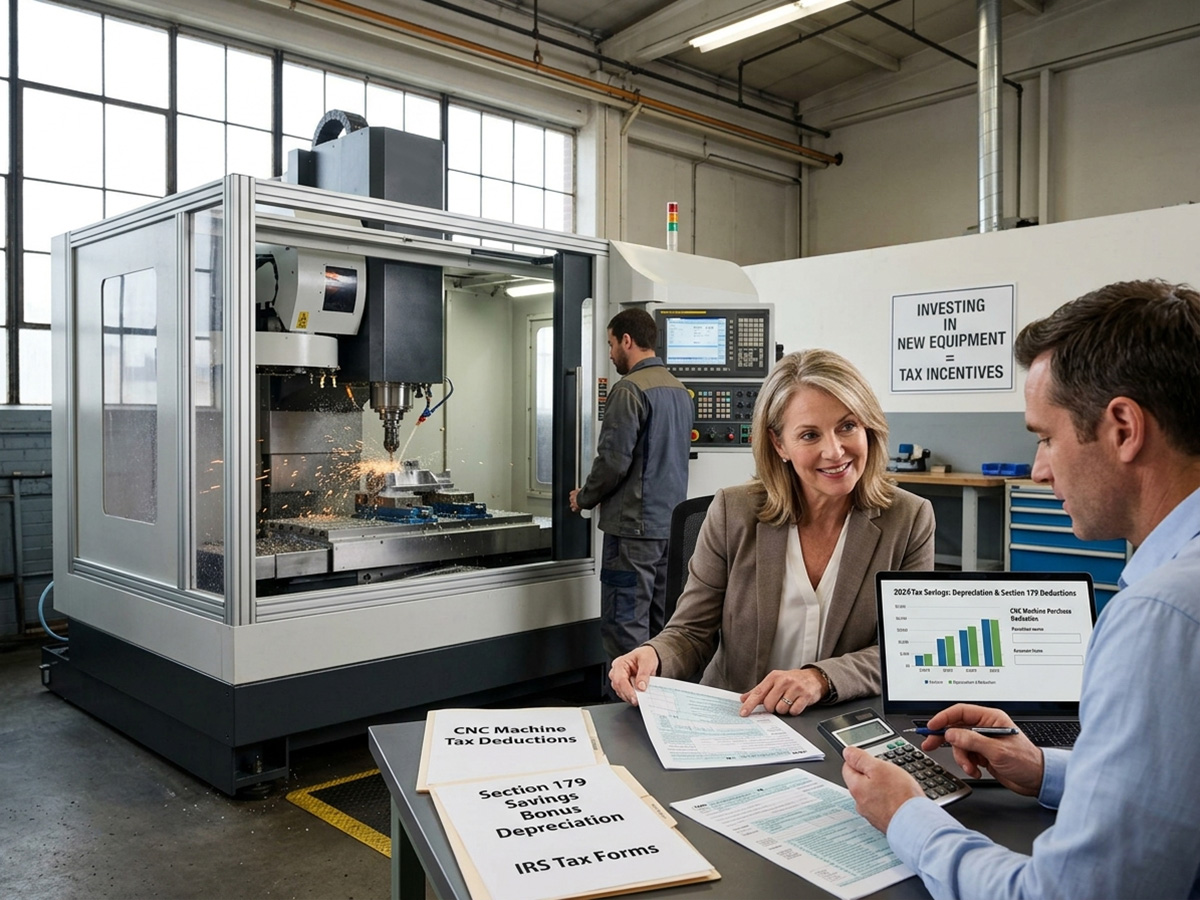
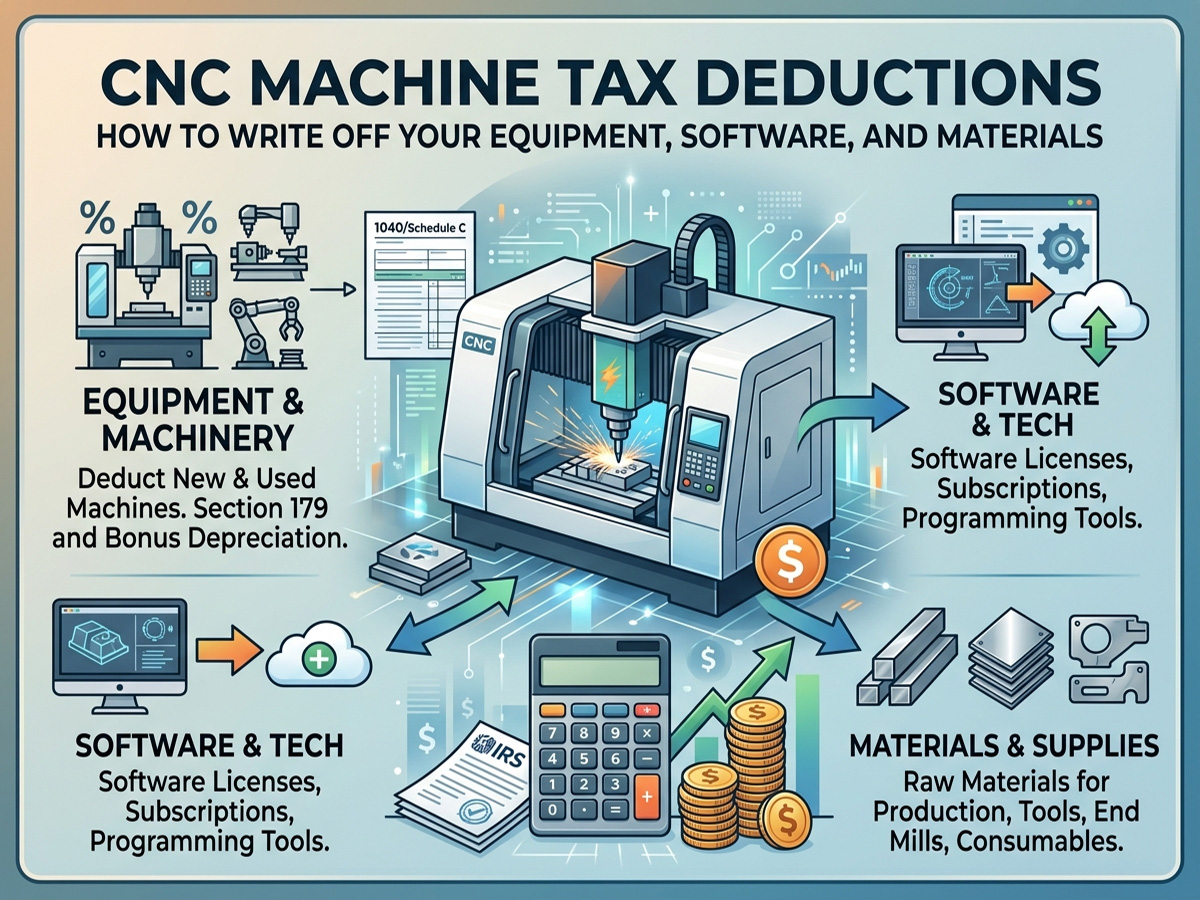
If you operate a CNC or laser business, whether full-time, as a side hustle, or from a home workshop, most of your operational costs are deductible. The IRS allows deductions for equipment, software, consumables, and workspace improvements when they are used for legitimate business purposes.
Complete Deduction Checklist
| Category | Deductible Items | Deduction Method |
|---|---|---|
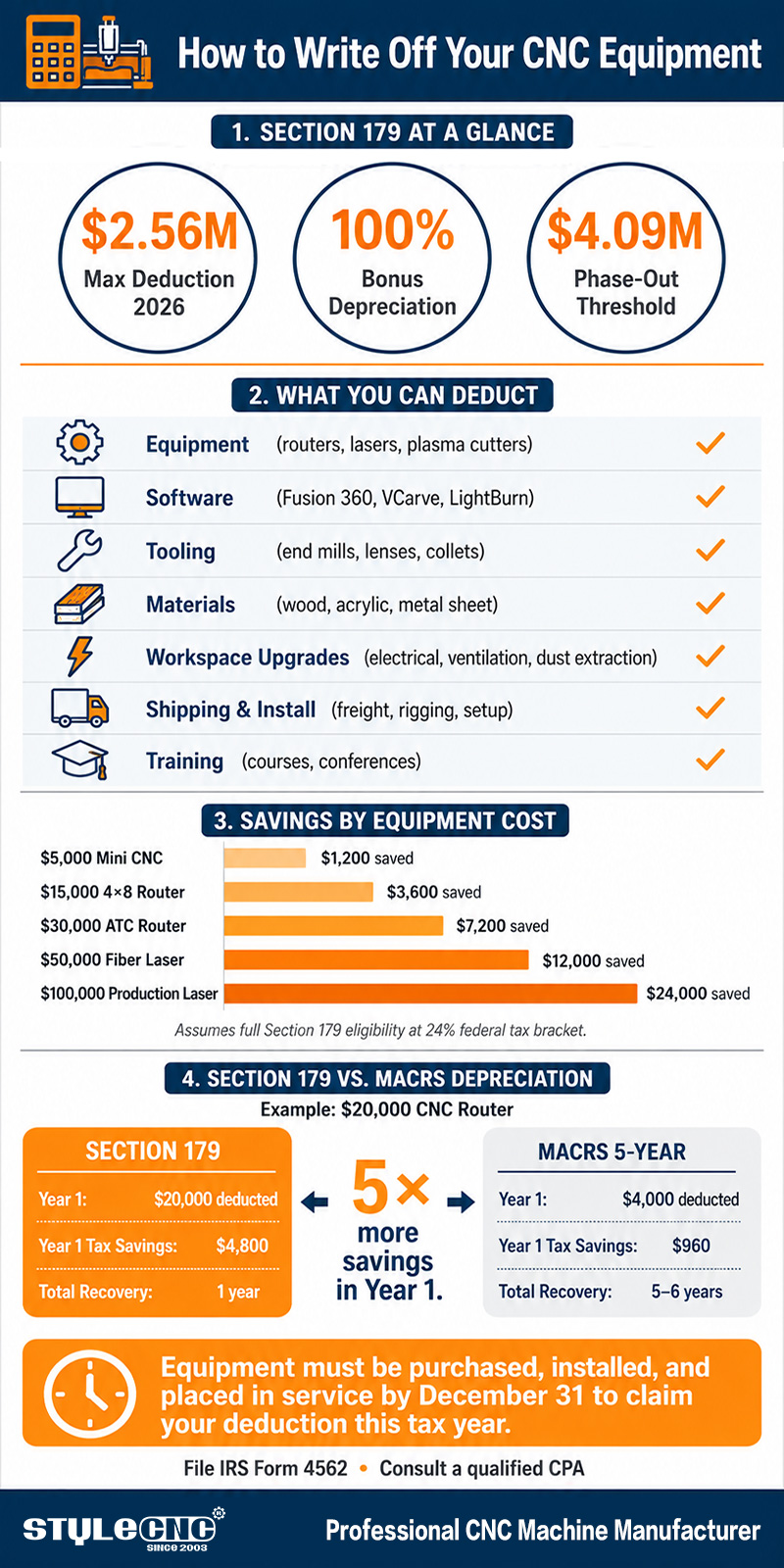
| Equipment | CNC routers, laser cutters, laser engravers, plasma cutters, spindles, rotary axes | Section 179 or Bonus Depreciation |
| Software | Fusion 360, VCarve, Aspire, LightBurn, SolidWorks, AutoCAD subscriptions | Section 179 (off-the-shelf) or Operating Expense |
| Tooling & Accessories | End mills, laser lenses, nozzles, collets, clamps, vacuum tables, dust collectors | Operating Expense (deducted fully in purchase year) |
| Materials & Consumables | Wood, acrylic, metal sheet, MDF, plywood, laser gas, coolant | Cost of Goods Sold (COGS) |
| Workspace Upgrades | Electrical panel upgrades, ventilation, dust extraction systems, concrete pads | Section 179 (Qualified Improvement Property) or Depreciation |
| Shipping & Installation | Freight costs, rigging, professional setup fees | Capitalized into equipment cost (included in Section 179 basis) |
| Training & Education | CNC courses, CAM training, industry conferences | Operating Expense |
When evaluating the full cost of a CNC router, including the machine, tooling, and software licenses, reviewing a detailed CNC router cost breakdown helps you identify every deductible component of your purchase.
Section 179 Expensing: The Most Powerful Write-Off for CNC Owners
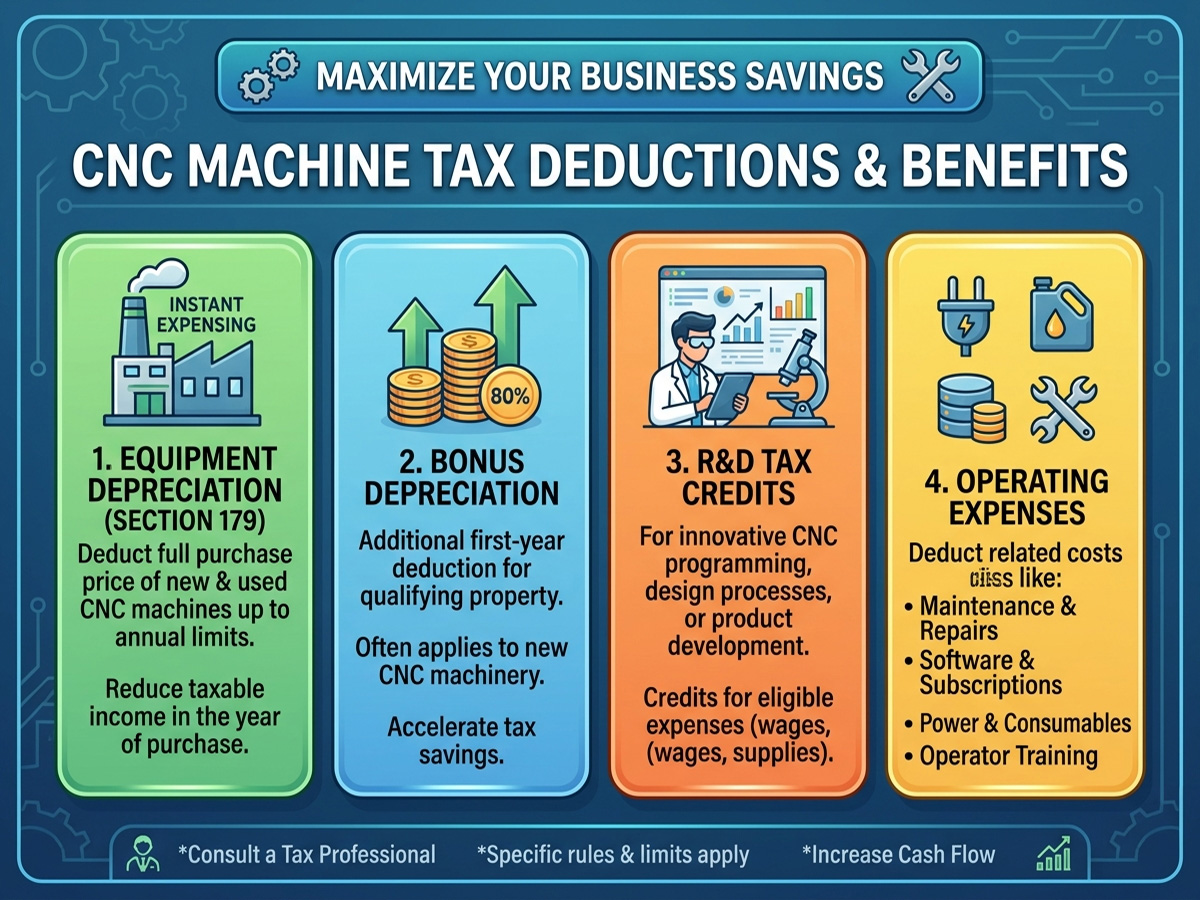
Section 179 of the Internal Revenue Code allows businesses to immediately deduct the full purchase price of qualifying equipment in the year it is placed in service. Instead of recovering the cost over five to seven years through standard depreciation, you claim the entire amount upfront.
Current Section 179 Limits
| Measurement | 2026 Tax Year |
|---|---|
| Maximum Section 179 deduction | $2,560,000 |
| Phase-out threshold begins at | $4,090,000 |
| Complete phase-out at | $6,650,000 |
| Bonus depreciation rate | 100% (reinstated by OBBBA, effective Jan 19, 2025) |
| Applies to new AND used equipment? | Yes – must be new to your business |
| IRS form required | Form 4562 (Depreciation and Amortization) |
The One Big Beautiful Bill Act (signed July 2025) doubled the Section 179 limit from $1.25 million to $2.5 million and restored 100% bonus depreciation, making this the most favorable equipment expensing environment since 2017. For CNC and laser buyers, this means a $15,000 router or a $50,000 fiber laser cutter can be fully written off in the year you start using it.
This applies whether you purchase a CNC woodworking machine for a cabinet shop, a laser engraver for a small business, or an industrial fiber laser system.
Section 179 vs. Standard Depreciation: Side-by-Side Comparison
To understand the real financial impact, compare how a $20,000 CNC router purchase plays out under each method.
| Measurement | Section 179 (Full Expense) | Bonus Depreciation (100%) | MACRS (5-Year) |
|---|---|---|---|
| Year 1 deduction | $20,000 | $20,000 | $4,000 (20%) |
| Year 2 deduction | $0 | $0 | $6,400 (32%) |
| Year 3 deduction | $0 | $0 | $3,840 (19.2%) |
| Years 4–6 | $0 | $0 | $5,760 remaining |
| Tax savings at 24% bracket (Year 1) | $4,800 | $4,800 | $960 |
| Can create a net loss? | No | Yes | N/A |
The key difference: Section 179 cannot create a net operating loss, while bonus depreciation can. If your taxable income is lower than the equipment cost, bonus depreciation lets you generate a loss that carries forward to offset future income. Your CPA can determine the optimal combination based on your specific tax situation.
Estimated Tax Savings: Quick Reference
Use this table to estimate your first-year tax savings based on equipment cost and tax bracket. These figures assume full Section 179 or bonus depreciation eligibility.
| Equipment Cost | 22% Bracket | 24% Bracket | 32% Bracket |
|---|---|---|---|
| $5,000 (Mini CNC router) | $1,100 | $1,200 | $1,600 |
| $15,000 (4x8 CNC wood router) | $3,300 | $3,600 | $4,800 |
| $30,000 (ATC CNC router) | $6,600 | $7,200 | $9,600 |
| $50,000 (Fiber laser cutter) | $11,000 | $12,000 | $16,000 |
| $100,000 (Production laser) | $22,000 | $24,000 | $32,000 |
These savings do not include state tax benefits, which vary. Some states fully conform to federal Section 179 limits, while others impose lower caps or decouple entirely. Always verify your state's rules with a tax professional.
Home-Based vs. Commercial Workshop: What Changes?
A common question CNC owners ask: "Does working from a home shop change my deductions?" The short answer is no, your equipment deductions remain the same regardless of location. However, home-based operators may qualify for additional deductions.
• Home Office Deduction: If your workshop occupies a dedicated space used exclusively for business, you can deduct a proportional share of rent/mortgage, utilities, insurance, and property tax.
• Simplified Method: The IRS offers a simplified calculation at $5 per square foot, up to 300 sq ft ($1,500 maximum).
• Utilities: Electricity consumed by your CNC machine, dust collector, and air compressor is deductible as a business expense proportional to usage.
• Insurance: Business liability insurance premiums and equipment floater policies are fully deductible.
Whether you run a home shop or a leased commercial space, understanding the full cost of CNC equipment and how to monetize your laser engraver helps maximize both revenue and deductible expenses.
Common Tax Mistakes CNC Business Owners Make
Avoiding these errors can save you thousands in missed deductions or unexpected tax bills:
• Not placing equipment in service by year-end: Section 179 requires the machine to be installed and operational by December 31. Ordering in November but receiving it in January pushes the deduction to the following tax year.
• Failing to track business-use percentage: Equipment must be used more than 50% for business to qualify for Section 179. If you share a CNC router between personal projects and business orders, maintain a usage log.
• Missing deductible soft costs: Shipping, installation, wiring upgrades, and training are all deductible, yet many operators forget to claim them.
• Not knowing state rules differ: Several states cap Section 179 at much lower limits or disallow bonus depreciation entirely. Check with your state's Department of Revenue.
• Ignoring the recapture rule: If business use drops below 50% within the recovery period (typically 5 years), you must recapture (repay) a portion of previously claimed deductions.
• Not filing Form 4562: You must file IRS Form 4562 with your tax return to claim Section 179. Missing this form means losing the deduction.
Frequently Asked Questions
Can I deduct a CNC machine if I finance it?
Yes. Section 179 applies to financed and leased equipment. You can deduct the full purchase price in the year the machine is placed in service, even if you are making monthly payments.
Does Section 179 apply to used CNC machines?
Yes. Both new and used equipment qualify, as long as the machine is new to your business. A pre-owned CNC router purchased from a dealer or private seller is eligible.
What if my business income is less than the equipment cost?
Section 179 deductions cannot exceed your taxable business income. However, 100% bonus depreciation has no income cap and can create a net operating loss that carries forward to offset future income.
Are CAD/CAM software subscriptions deductible?
Yes. Off-the-shelf software like Fusion 360, VCarve, and LightBurn qualifies for Section 179 expensing. Annual subscription fees are also deductible as ordinary business expenses.
Can I claim a deduction for a laser engraver used in a side business?
Yes, provided you operate the side business with a genuine profit motive and use the equipment more than 50% for business. Maintain records of business vs. personal usage.
Where can I learn more about IRS equipment depreciation rules?
The official IRS guidelines are published in IRS Publication 946 (How to Depreciate Property) and the instructions for Form 4562. For up-to-date Section 179 limits, visit Section179.org.
Plan Your Equipment Purchase Strategically
With Section 179 limits at historic highs and 100% bonus depreciation reinstated, now is the most advantageous time to invest in CNC and laser equipment. Explore the STYLECNC buyer's guide for your first CNC router or review the complete laser engraver and cutter lineup to find the right machine for your business and your tax strategy. Always consult a qualified CPA or tax professional before making purchase decisions based on tax incentives.