What Does ROI Mean for a CNC or Laser Business?
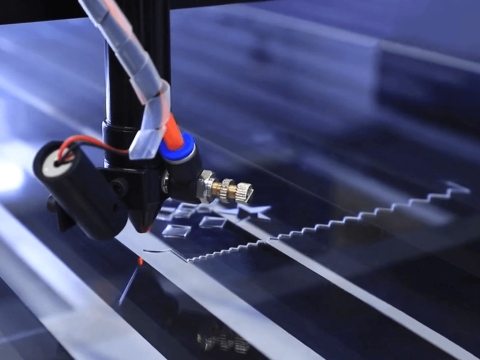
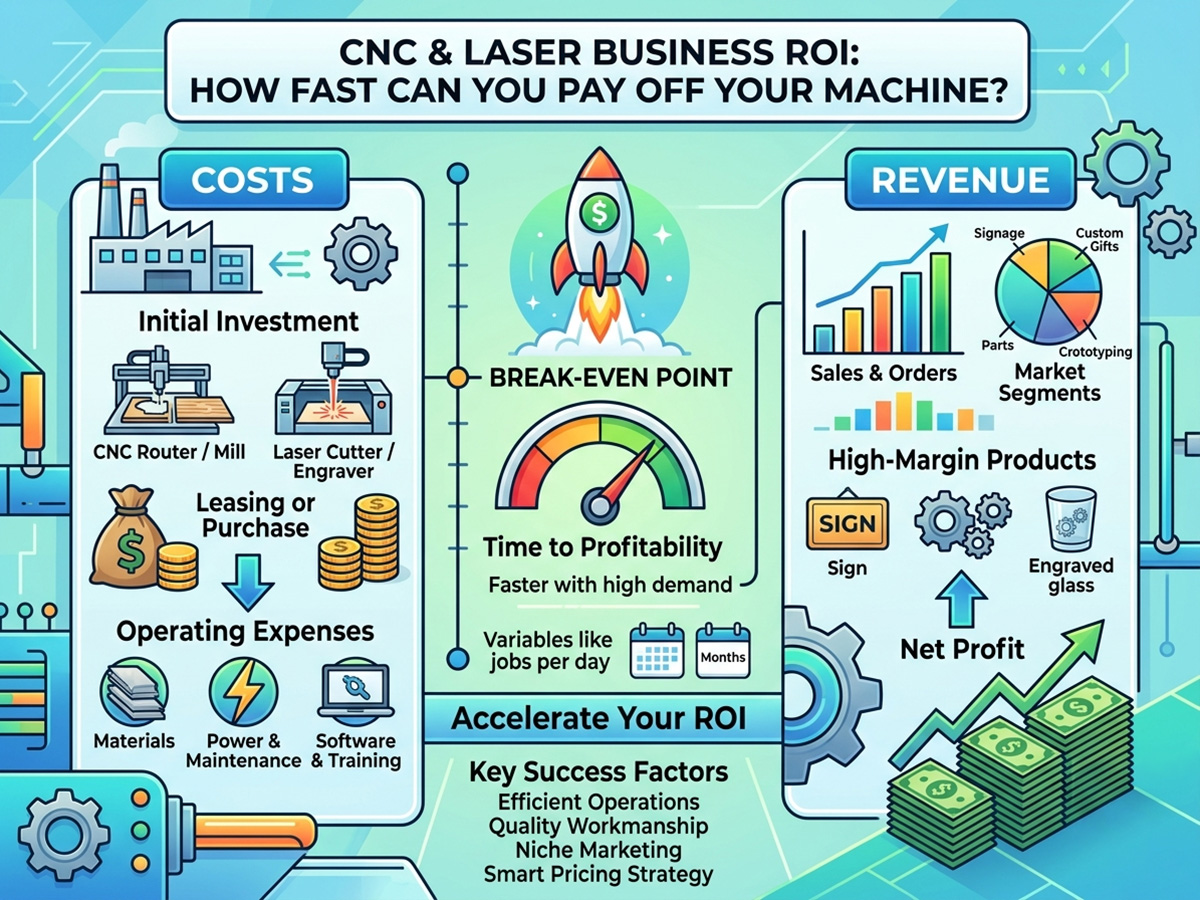
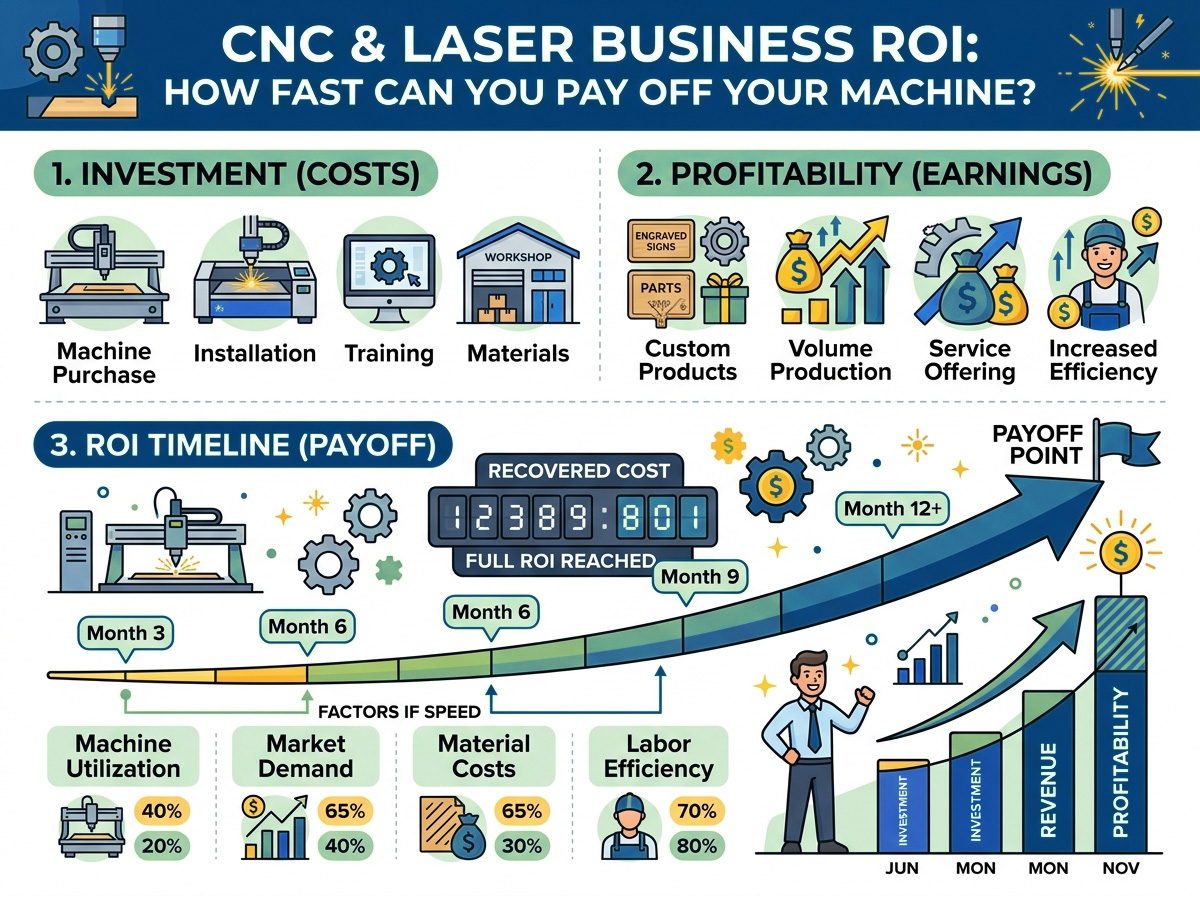
Return on investment (ROI) for CNC and laser equipment measures the total net financial benefit your machine generates divided by the total cost of owning and operating it. Unlike general business ROI, machine-level ROI factors in labor displacement, material waste reduction, increased production capacity, and the ability to take on higher-margin contracts that manual methods cannot support.
A positive and rapidly growing ROI means your equipment is outperforming older, slower, or manual processes. For shop owners evaluating a CNC router or CNC laser machine, the ROI calculation provides the clearest path from capital risk to financial reward.
ROI Formula: (Annual Net Profit from Machine - Annual Operating Costs) / Total Investment Cost x 100.
Typical Payback Periods by Machine Type
Payback periods vary based on machine category, price point, and how aggressively the owner pursues revenue. The table below summarizes realistic timelines drawn from manufacturer data and shop-owner reports across forums and industry surveys.
| Machine Type | Investment Range | Typical Payback | Monthly Profit Potential | Utilization Target |
|---|---|---|---|---|
| Desktop CNC Router | $2,000 - $8,000 | 3 - 8 months | $500 - $2,000 | 40 - 60% |
| Full-Size CNC Router (4x8) | $15,000 - $60,000 | 8 - 18 months | $2,000 - $8,000 | 60 - 80% |
| CO2 Laser Engraver | $2,000 - $15,000 | 4 - 12 months | $1,000 - $5,000 | 50 - 70% |
| Fiber Laser Cutter | $30,000 - $200,000 | 6 - 24 months | $5,000 - $15,000+ | 70 - 85% |
| CNC Plasma Cutter | $8,000 - $50,000 | 6 - 18 months | $2,000 - $7,000 | 55 - 75% |
| Measurement | USD (approx.) | Months | USD/month | Beam-on hours (%) |
Shop owners on WOODWEB and Practical Machinist consistently report that well-utilized CNC routers pay for themselves within the first year. One cabinetry shop investing $110,000 in a router and software recovered the full cost in 12 months by eliminating two employee positions and doubling production output.
Key Factors That Accelerate or Delay Your Payback
Factors That Speed Up ROI
• High utilization rate: Running your machine at 60% or more beam-on time compresses payback dramatically. Every 10% utilization gain can shorten recovery by roughly 30%.
• Repeat production work: Custom signs, cabinet parts, and engraved products with predictable demand create consistent revenue that supports monthly payments.
• Pricing discipline: Charging based on value delivered rather than time spent protects margins. Underpricing is the most common profitability killer among new CNC owners.
• Parallel productivity: While the machine runs unattended, operators handle assembly, finishing, or customer interactions. This effectively doubles shop output.
• Niche specialization: Targeting high-demand verticals like wedding keepsakes, corporate awards, architectural metalwork, or custom furniture yields higher margins than general fabrication.
Factors That Delay ROI
• Buying more machine than needed: Forum users on CNCZone and WOODWEB caution that overinvesting in capacity you cannot fill leads to crushing monthly payments without matching revenue.
• Neglecting software investment: Experienced operators emphasize that spending on quality CAM software is as important as the machine itself. Poor software limits what your hardware can produce.
• Extended learning curves: Complex operations like dovetail drawers or 3D relief carving require months of programming refinement before reaching efficient production speeds.
• Downtime from poor support: Machines sitting idle due to parts delays or service lag destroy ROI timelines. Operators on Practical Machinist stress the importance of choosing vendors with responsive technical support.
Real-World ROI Scenarios
Scenario 1: Small Woodworking Shop with CNC Router
A two-person woodworking shop invests $25,000 in a mini CNC router for small business use, including software. The machine handles sign cutting, plaque carving, and custom parts. Monthly operating costs run approximately $400 (electricity, tooling, maintenance). At 20 jobs per week averaging $150 per job, monthly gross revenue reaches $12,000. After subtracting $3,000 in materials and $400 in operating costs, monthly net contribution is $8,600. The machine pays for itself in under three months.
Scenario 2: Laser Engraving Startup
A home-based entrepreneur purchases a $5,000 CO2 laser engraving machine and sells personalized gifts on Etsy. Monthly expenses total roughly $300 (materials, electricity, platform fees). Selling 100 customized items per month at an average of $25 each generates $2,500 in revenue. Net monthly profit of approximately $2,200 means the machine breaks even in about two and a half months. Operators in the LightBurn Forum and Reddit r/lasercutting communities confirm that focused seasonal sellers often recover costs even faster during holiday periods.
Scenario 3: Metal Fabrication Shop with Fiber Laser
A fabrication shop currently outsourcing laser cutting spends $7,500 per month on external services. They invest $80,000 in a fiber laser cutting machine. Monthly operating costs (gas, electricity, consumables, one operator) total approximately $3,000. By bringing cutting in-house, the shop saves $4,500 per month net. Payback occurs in approximately 18 months, and every month afterward adds directly to the bottom line.
How to Calculate Your Own Payback Period
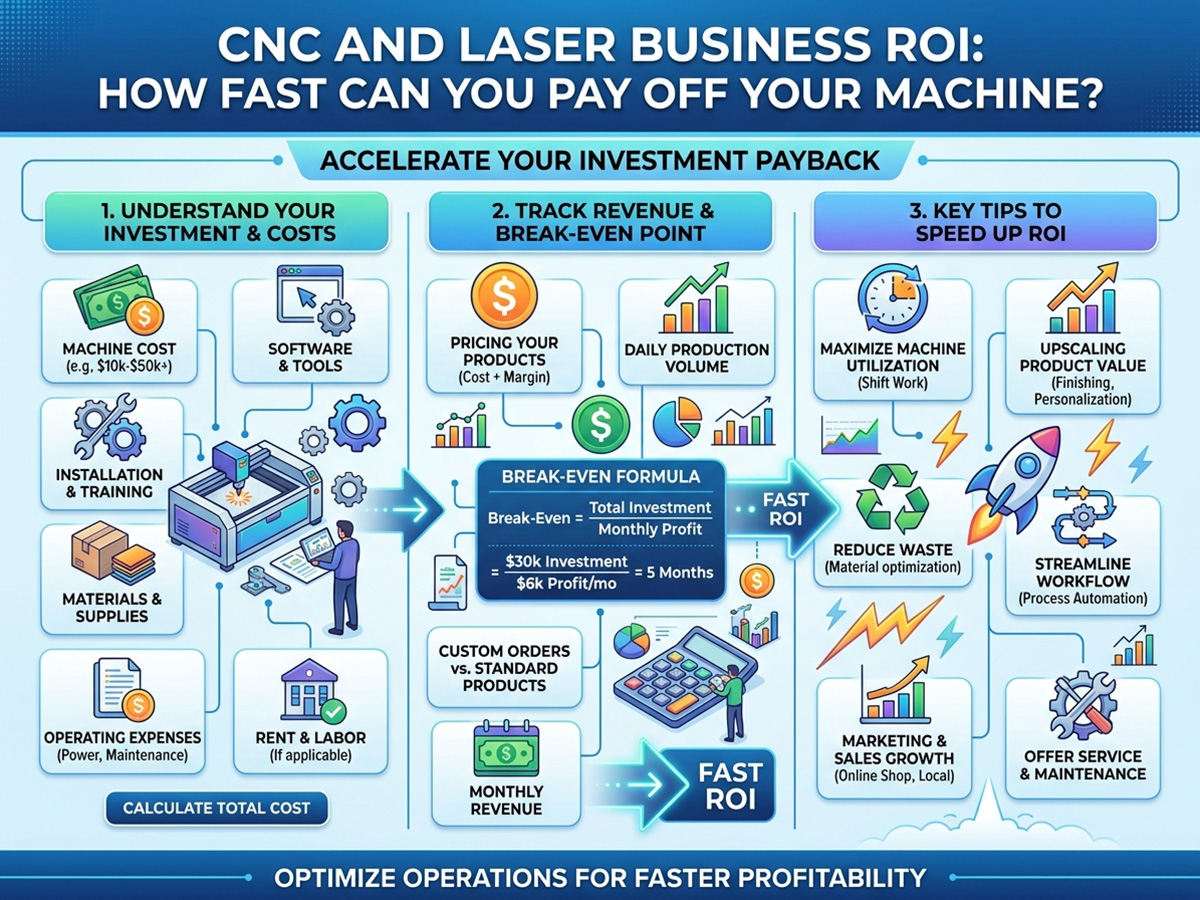
Use this step-by-step framework to estimate your specific machine payback timeline.
Step 1: Total your investment costs
• Machine purchase price (including shipping, taxes, and import duties)
• Installation, electrical prep, and ventilation setup
• Software licenses and training
• Accessories (rotary attachments, exhaust systems, tooling kits)
Step 2: Estimate monthly operating costs
• Electricity (500 to 1,500W machines cost roughly $20 to $75/month at typical rates)
• Consumables (bits, lenses, nozzles, laser tubes)
• Materials for your primary product lines
• Maintenance and preventive service
Step 3: Project monthly revenue
• Research market rates for your target products (custom signs, engraved gifts, cut parts)
• Estimate realistic production capacity per shift
• Use conservative numbers rather than best-case projections
Step 4: Apply the payback formula
Payback Period (months) = Total Investment / (Monthly Revenue - Monthly Operating Costs)
If even your conservative estimate shows payback within 24 months, the investment carries manageable risk. If it only works in a best-case scenario, reconsider the machine size or your target market before committing.
Common ROI Mistakes to Avoid
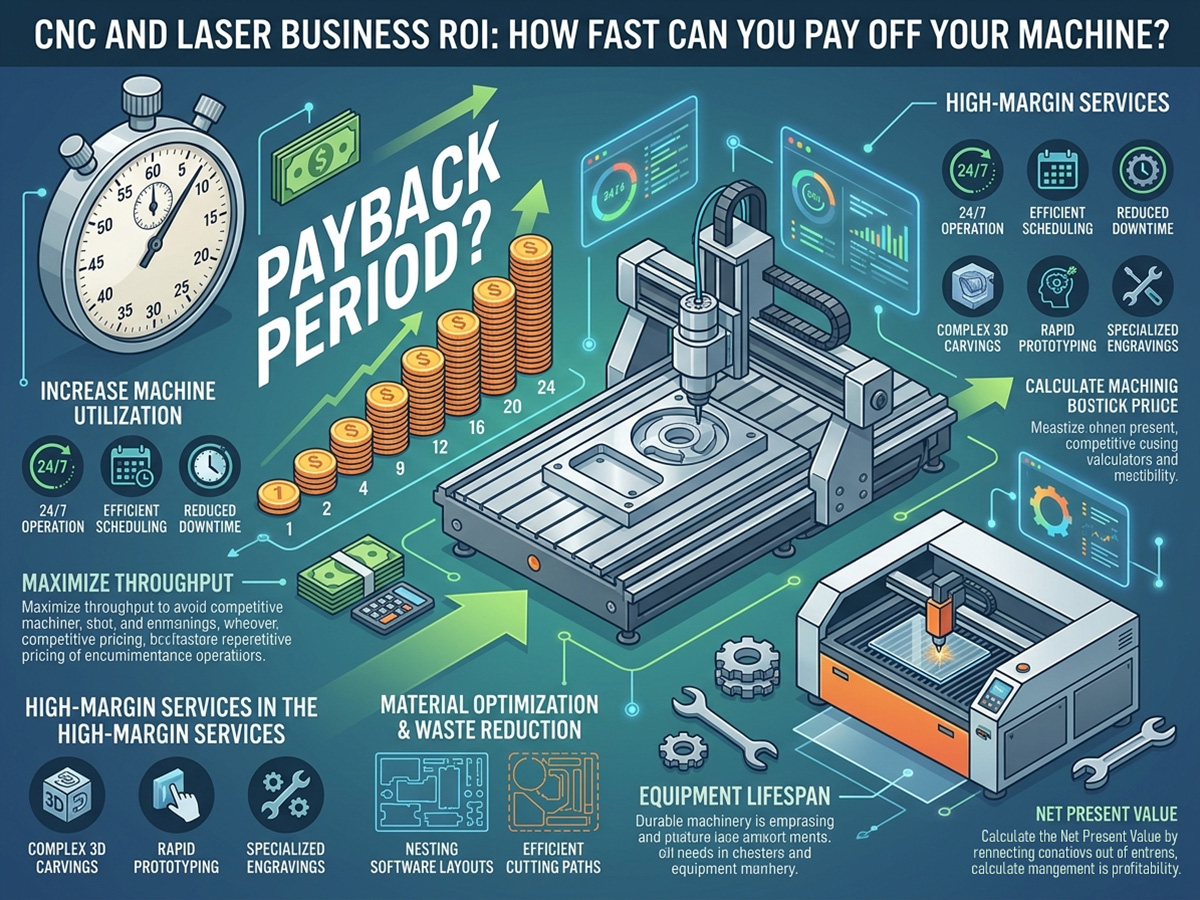
Experienced CNC and laser business owners across Reddit, Signs101, and WOODWEB frequently warn about these avoidable errors that destroy profitability. Avoiding these pitfalls is critical whether you are exploring laser engraver costs and benefits for a startup or scaling an established operation.
✓ Buying a $100,000 machine when a $20,000 unit covers 90% of your workload
✓ Skimping on CAM/CAD software and limiting what the hardware can actually produce
✓ Pricing products based on material cost alone instead of factoring in machine time, labor, and overhead
✓ Ignoring maintenance schedules and then facing catastrophic spindle or laser tube failures
✓ Assuming the machine will stay busy without active marketing, sales outreach, or an online storefront
✓ Calculating ROI using best-case utilization instead of realistic 60 to 70% beam-on rates
✓ Failing to account for the learning curve period when productivity is low and material waste is high
Which CNC or Laser Machine Offers the Fastest ROI?
The fastest payback depends on your business model, not the machine alone. However, certain categories consistently deliver quicker returns based on lower entry costs, broad market demand, and high per-unit margins.
| Business Model | Best Machine Fit | Why ROI Is Fastest |
|---|---|---|
| Personalized gifts and decor (Etsy, Shopify, markets) | CO2 laser engraver ($2K - $8K) | Low entry cost, high margins (50 - 70%), strong seasonal demand |
| Custom signage and woodworking | CNC router ($5K - $30K) | Repeat orders, labor savings, proven demand across industries |
| Metal fabrication (job shop or in-house) | Fiber laser cutter ($30K - $200K) | Eliminates outsourcing costs, handles thick metals, enables rapid prototyping |
| Cabinet and furniture production | Industrial CNC router ($20K - $80K) | Replaces multiple employees, nested cutting minimizes waste |
| Mixed material cutting (metal + nonmetal) | Hybrid laser cutter ($10K - $40K) | Single machine covers diverse jobs, reduces equipment redundancy |
For entrepreneurs exploring how to start your business with a laser cutter, beginning with a versatile mid-range machine and proven product line minimizes risk while maximizing early cash flow.
Maximizing Long-Term Profitability After Payback
Once your machine has paid for itself, every subsequent dollar of revenue flows more directly to profit. The most successful CNC and laser businesses use these strategies to compound returns over time.
• Diversify product lines: Add complementary offerings. A sign shop with a CNC router can add laser-engraved plaques. A laser engraving business can expand into cutting services.
• Batch production: Group similar jobs together to minimize setup time and maximize uninterrupted cutting hours. Switching between materials and programs eats into productive capacity.
• Automate where possible: Material loaders, automatic tool changers, and job tracking software reduce manual intervention and increase throughput per operator.
• Reinvest strategically: Use profits from the first machine to fund a second unit. Most shop owners recommend validating profitability before scaling, not buying the third machine until the first two are clearly earning.
• Pursue high-value contracts: Corporate branding, architectural installations, and industrial parts carry larger order values and longer-term relationships than one-off consumer products.
Frequently Asked Questions
How long does it take for a CNC router to pay for itself?
Most CNC routers pay for themselves within 6 to 18 months depending on utilization and pricing strategy. Desktop models under $10,000 often break even in under 6 months. Full-size industrial routers typically recover costs within 12 to 18 months at consistent production volumes.
Is a laser engraving business actually profitable?
Laser engraving businesses routinely achieve profit margins between 50% and 70% on personalized products. Operators focusing on high-demand niches like corporate awards, wedding keepsakes, and custom home decor report the strongest returns with low material overhead.
What is a good utilization rate for a CNC or laser machine?
A utilization rate of 60% to 80% is considered healthy for most shop environments. This accounts for setup time, maintenance, and material handling. Pushing above 85% is achievable in high-volume production but requires strict workflow optimization.
Can I start a CNC business part-time and still see ROI?
Part-time CNC businesses are viable, though payback periods extend proportionally. A machine running 15 to 20 hours per week instead of 40 may take 12 to 24 months to break even rather than 6 to 12. The key is maintaining pricing discipline and targeting profitable product categories.
What hidden costs should I include in my ROI calculation?
Factor in electricity, consumable tooling (bits, lenses, nozzles), software subscriptions, dust collection or exhaust systems, compressed air or assist gas, and preventive maintenance parts. Ignoring these costs inflates projected returns and leads to disappointing real-world results.
Should I finance or pay cash for a CNC machine?
Financing preserves working capital for materials, marketing, and operations. Many shop owners find that monthly lease payments are lower than their previous outsourcing bills, making the switch cash-flow positive from the first month. Equipment tax deductions can further offset total cost.
Final Thoughts
The math behind CNC and laser machine ROI is straightforward: total your costs, project conservative revenue, and divide. The nuance lies in execution. Owners who treat their machines as revenue-generating assets rather than workshop accessories consistently recover their investment faster and build more resilient businesses. Whether you are comparing laser engraver costs and earning potential for a first purchase or evaluating a capacity upgrade, grounding your decision in realistic financial modeling eliminates guesswork and positions your operation for long-term profitability.