MDF or Plywood: The Short Answer
Plywood, specifically Baltic birch with PVA glue, is better for laser cutting when strength, visible edges, and natural wood looks matter: it cuts cleaner with less charring. MDF is better for painted signage, engraving, and flat prototypes: it is cheaper, perfectly uniform, and cuts predictably, but chars darker, weighs about 15 percent more, and releases more fumes. Match the board to the project, not to a single winner.
The Head-to-Head Comparison
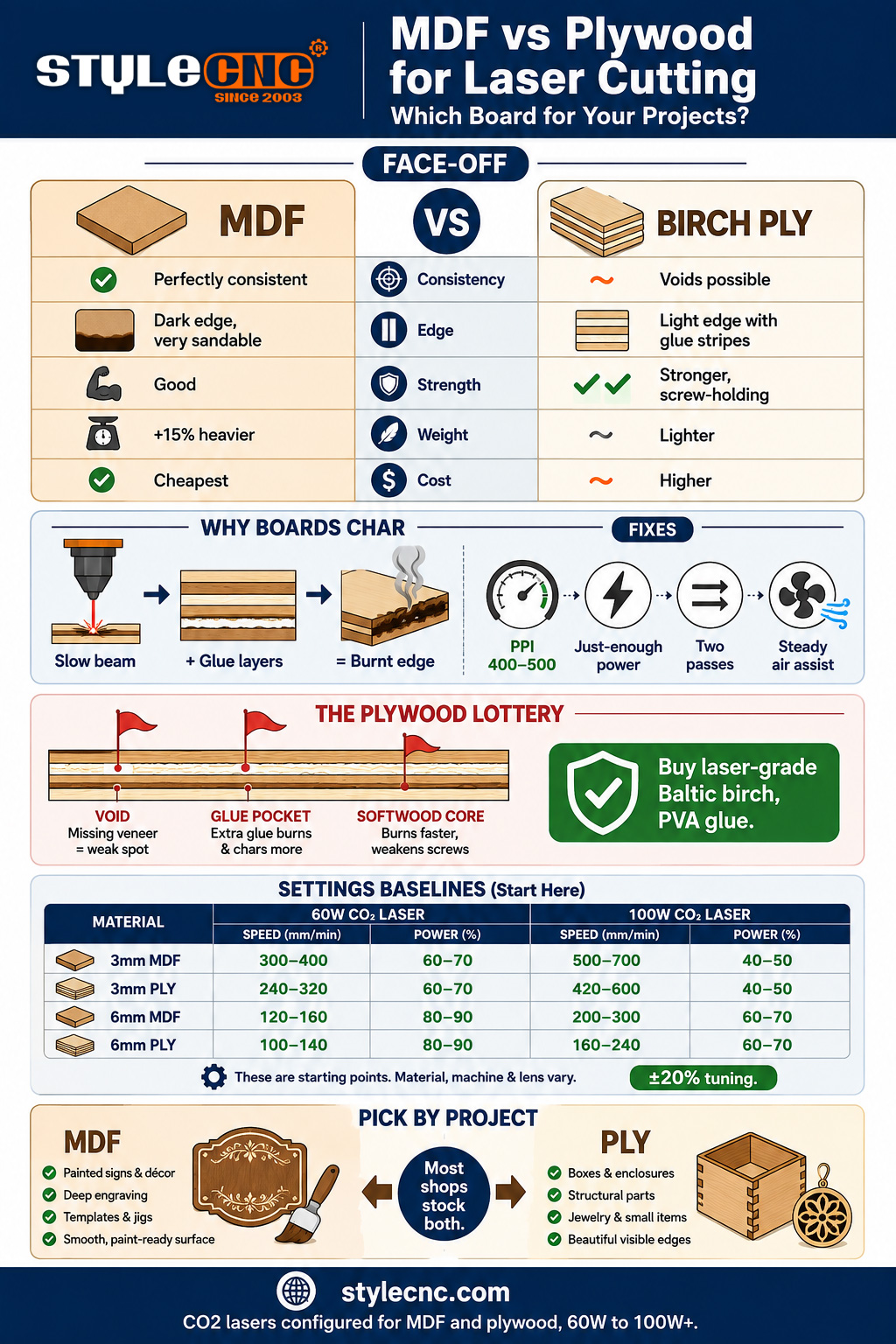
| Factor | MDF | Plywood (Baltic Birch) |
|---|---|---|
| Measurement | 3 to 6 mm board, 60 to 100 W CO2, air assist on | Same basis, laser-grade birch with PVA glue |
| Cut consistency | Perfectly uniform density; every cut identical | Layer and glue variation; occasional voids and flare-ups |
| Edge color | Dark brown to black char; sands off easily | Light-to-medium brown; embedded dark glue lines cannot be sanded out |
| Charring tendency | Higher; resin binder chars readily | Lower on quality birch; heavy on construction-grade glues |
| Strength | Weaker; snaps and sags under load | Stronger in every direction; holds joints and tabs |
| Weight (3 mm) | About 15 percent heavier | Lighter; better for shipped products |
| Fumes and smoke | More; formaldehyde-bearing VOCs, strict extraction needed | Less, but glue-dependent; dirty adhesives smoke heavily |
| Cost | Cheapest sheet on the rack | 2 to 4x MDF for laser-grade birch |
| Best projects | Painted signs, engraving blanks, templates, prototypes | Boxes, structural parts, jewelry, visible-wood products |
Char and Edge Color: What the Forums Learned the Hard Way
Charring happens when material burns instead of vaporizing, and a Sawmill Creek member who ran hundreds of comparative tests across plywood, MDF, and hardboard reached the community's core conclusion: the glues and resins in engineered boards always char more than pure wood, leaving a loose sooty deposit that transfers to hands. Two settings lessons came out of those threads. Keep frequency or PPI low, around 400 to 500 rather than defaults in the thousands, and use only enough power to just make it through, taking two passes rather than one over-powered pass when a clean edge matters.
The two boards char differently in a way that decides finishing. MDF chars dark and evenly, but the soot sits on homogeneous fiber and sands off in seconds, which is why painted-product makers do not fear it. Plywood chars less overall on quality birch, but its dark lines are the glue layers themselves, embedded in the edge where no sanding reaches. If the edge will be visible and natural, the plywood stripe pattern is the look; if the edge will be painted, MDF's sandable char is the easier path.
The Plywood Glue-Layer Lottery
Plywood's weakness is that you cut what the mill hid. LaserUser forum veterans list the failure modes from experience: voids in the core that flare or leave uncut bridges, glue strings and dense adhesive pockets that stall the beam, and softwood cores swapped in beneath hardwood faces to save cost. Their verdict on ordinary construction plywood is blunt: the standard adhesive is dirty near a laser, and box-store sheets are a gamble per sheet.
✓ Buy laser-grade Baltic birch: Solid birch veneers in every ply, minimal-void cores, and PVA glue that cuts cleanly. This is the plywood the comparison table assumes.
✗ Avoid phenolic and WBP exterior glues: Construction and exterior-grade sheets char heavily, soot the optics, and cut inconsistently.
✗ Check for PVC-bearing adhesives: Some imported decorative sheets bond layers with chlorinated adhesives, which moves them onto the never-cut list entirely. Unbranded mystery plywood deserves a supplier spec before it meets the beam.
Smoke, Fumes, and Resin Buildup
MDF is the smokier board. Its urea-formaldehyde binder releases VOCs that make strong extraction non-negotiable, and its fine combustion residue coats lenses and mirrors faster than plywood smoke does. Plywood's fume load depends almost entirely on its glue, which is one more argument for the PVA-bonded birch. For both boards, the practical routine is the same: steady medium air assist (more is not better; a stable moderate flow is the community sweet spot), extraction running before the job starts, and a lens check on a schedule tied to how much engineered board the machine eats.
Settings Comparison: MDF vs Plywood Baselines
Baseline CO2 cutting windows for the two boards, tuned from published machine data and forum practice. Treat them as starting points and adjust roughly 20 percent either way for your glue, airflow, and lens condition.
| Board and Thickness | 60 W CO2 Starting Point | 100 W CO2 Starting Point |
|---|---|---|
| 3 mm MDF | 15 to 20 mm/s at 70 to 80% power | 25 to 35 mm/s at 60 to 70% power |
| 3 mm birch plywood | 18 to 22 mm/s at 65 to 75% power | 28 to 38 mm/s at 55 to 65% power |
| 6 mm MDF | 8 to 10 mm/s at 85 to 95%, or two passes | 14 to 18 mm/s at 75 to 85% power |
| 6 mm birch plywood | 9 to 12 mm/s at 80 to 90% power | 16 to 20 mm/s at 70 to 80% power |
The wattage lesson inside the table: higher power is not about brute force but about speed, since a 100 W tube crossing the sheet nearly twice as fast gives the glue less dwell time to char. Full parameter methodology, focus, and engraving settings for wood are covered in the laser engraving and cutting wood guide, and the 100W CO2 wood laser cutting machine is the power class where 6 mm boards move from two-pass work to single-pass production.
Which Board for Which Project
✓ Choose MDF for: Painted signage and lettering, engraving blanks and photo panels, jigs, templates, fit-check prototypes, and any flat product where uniformity beats strength and the edge gets paint.
✓ Choose plywood for: Finger-joint boxes and enclosures, structural and load-bearing parts, laser-cut jewelry and ornaments, products shipped by weight, and anything sold with visible natural wood edges and faces.
✓ Stock both: Most working shops prototype in cheap MDF, then cut the sellable version in birch. Same file, two boards, each doing the job it is best at.
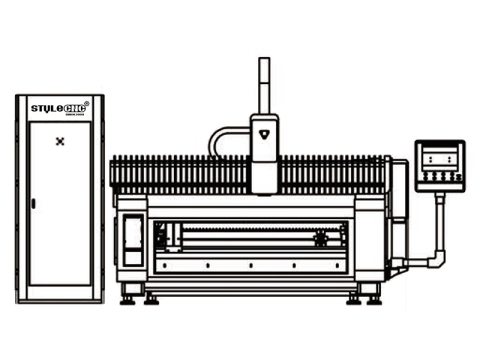
Machine-wise, this pairing is exactly what the affordable laser cutter for plywood, MDF, and plastic class is configured for: CO2 platforms with the air assist, extraction, and power range that both boards demand. Tell the STYLECNC team your board thicknesses and daily volume for a wattage recommendation grounded in the settings table above.
Frequently Asked Questions
Is MDF or plywood easier to laser cut?
MDF is easier to cut predictably: its density is perfectly uniform, so a dialed setting cuts identically across the whole sheet and every sheet after it. Plywood cuts cleaner on quality birch but carries per-sheet risk from voids, glue pockets, and hidden softwood cores that can flare or leave uncut spots. Forum consensus splits the same way: MDF for repeatability, laser-grade birch plywood for edge quality and strength.
Why does my MDF char so much when laser cutting?
Usually dwell time. Charring means the board is burning instead of vaporizing, and the fixes from the Sawmill Creek testing threads are to lower frequency or PPI to around 400 to 500, cut faster with just enough power to sever, run steady medium air assist, and take two lighter passes on thick board instead of one slow heavy one. MDF's resin binder will always char somewhat; the good news is its soot sands off in seconds, unlike plywood's embedded glue lines.
What is the best plywood for laser cutting?
Laser-grade Baltic birch bonded with PVA glue. Its solid birch veneers in every layer, low-void core, and clean-cutting adhesive make it the reference plywood across laser forums. Avoid construction-grade sheets with phenolic resin, exterior WBP-glued plywood, and any unbranded sheet whose adhesive cannot be identified, since some imported decorative boards use chlorinated glues that belong on the never-cut list, not the laser bed.
Are MDF laser cutting fumes dangerous?
They need respect. MDF's urea-formaldehyde binder releases formaldehyde-bearing VOCs when cut, so an enclosed machine with working extraction is the operating requirement, not an upgrade. With proper exhaust the process is standard shop practice worldwide. The related habit is keeping the optics clean, because MDF residue coats lenses faster than most materials and a fouled lens turns into charring and fire risk.
What laser power do I need for MDF and plywood?
For 3 mm boards, 40 to 60 W cuts comfortably in single passes. At 6 mm, a 60 W machine works but often wants two passes for clean edges, while 100 W cuts 6 mm in one pass at nearly double the speed, which also reduces charring by shortening dwell time. Production shops running daily 6 mm work land on the 100 W class for exactly that speed-equals-cleanliness reason.
The Bottom Line
There is no single winner, only a clean division of labor. MDF is the uniform, cheap, paint-ready board for signage, engraving, and prototypes, priced for experiments and forgiven its dark sandable char. Baltic birch plywood is the strong, light, good-looking board for boxes, structural parts, and products sold on their edges, worth its premium and its per-sheet lottery when the glue is PVA and the supplier is known. Keep frequency low, speed honest, extraction running, and both boards will behave.
STYLECNC covers the pairing from the affordable plywood and MDF laser cutter class through the 100W wood cutting machine for single-pass 6 mm production. Send your board list and volumes for a configuration matched to the work.