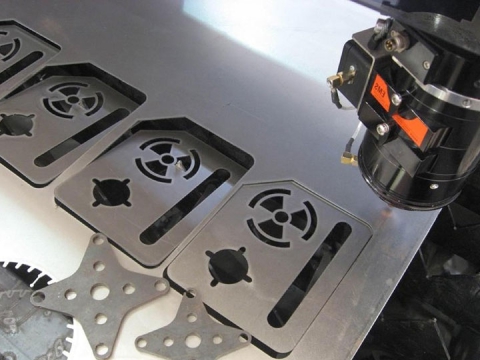
The cutting accuracy of fiber laser cutting system is currently the main standard parameter used to measure the quality of machine tools in the industry. In the equipment sales link, sales personnel will have a specific description of the processing performance of the product. Among them, the cutting accuracy of fiber laser cutter machine is mostly 0.5mm error range, of course, a few manufacturers provide high-precision laser cutting machine tools with processing accuracy up to 0.3mm error, but overall there is still a certain error range in cutting accuracy, which is what we call processing scale tolerance.
The work of the fiber laser metal cutting machine is based on the design of the company's cutting drawings, and the general part cutting drawings have clearly marked tolerance areas and values. Considering that the position of the tolerance zone of the cutting parts cannot be consistent, in the actual cutting process, it is possible to eliminate the above-mentioned tolerance zone through a variety of technological means.
In the programming of fiber laser cutting system, if the methods and techniques are used properly, it is of great significance to ensure and improve the processing accuracy of CNC machine tools. Many dimensions of parts are marked with tolerances, and the position of the tolerance zone can not be consistent, and the NC program is generally compiled according to the contour of the part, that is, according to the basic size of the part, ignoring the influence of the position of the tolerance zone. In this way, even if the precision of the CNC machine tool is very high, the processed parts may not meet its dimensional tolerance requirements.
In terms of processing methods and methods, you can first consider using radius compensation to compensate for the impact of cutting tolerances. This type of method is relatively simple for actual cutting operations. The specific idea is to still program and execute on the fiber laser cutting machine control system according to the basic size. That is, the calculation and programming are still based on the basic size of the part, and the same turning tool is used to machine all external circles, and different tool radius compensation values are used when machining dimensions with different tolerance zones. With this method, you must first know the radius of the tool tip arc (the machining track of this part is parallel to the X axis and Z axis, you don't need to know the radius of the tool tip arc), so it is inconvenient to use, and it can only be applied to some CNC systems.
The above process may be relatively complicated in the later cutting operation. If the size of the cut piece can be appropriately modified according to the drawing requirements in the early stage of cutting, it is also feasible to eliminate the influence of the tolerance area. The specific idea is to change the basic size and the position of the tolerance zone; The implementation aspect is to adjust the basic size and the position of the tolerance zone on the premise that the limit size of the part remains unchanged.
Generally adjusted according to the symmetrical tolerance zone, the adjusted basic size and tolerance. The programming is carried out according to the adjusted basic size, so that the same turning tool and the same tool compensation value (the processing path is parallel to the X axis and Z axis in this example, and tool compensation is not required) can ensure the machining accuracy. Of course, if the part needs to be finished (such as fine grinding) in the end, the basic size can also be slightly enlarged to ensure sufficient grinding allowance (at this time, the tolerance zone is asymmetric).
What factors determine the cutting precision of fiber laser cutting machine? Let's look at the specific.
When we want to cut the metals with more accuracy by a fiber laser cutting system, we must understand which aspects will affect the accuracy of the cutting, we will briefly introduce you to the following:
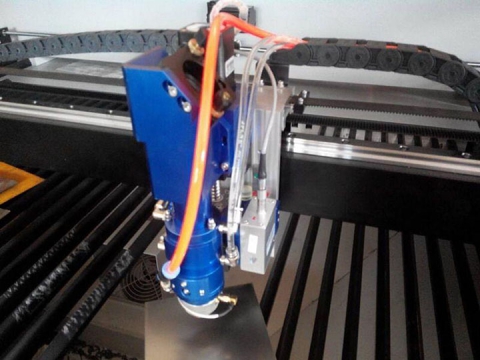
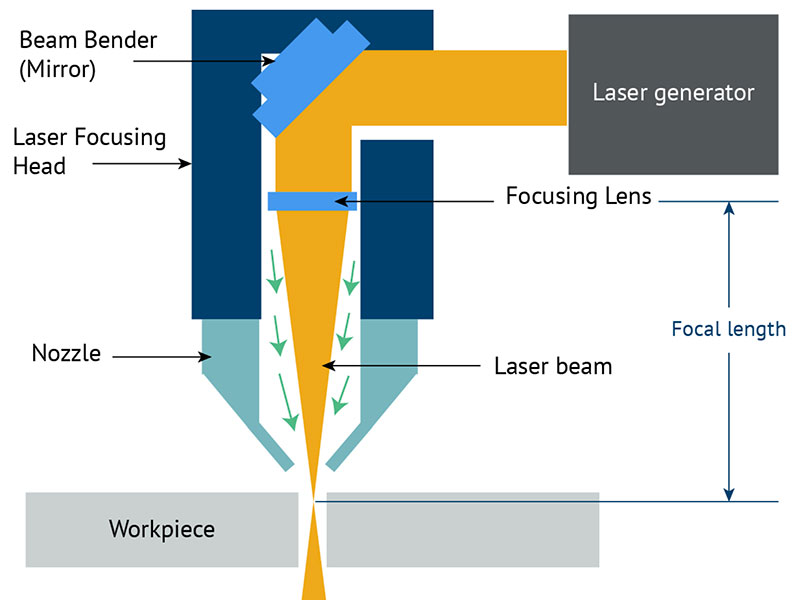
1. The laser beam emitted is tapered, so the cutting slit is also tapered, in this case, the slit of 1mm stainless steel will be much smaller than the 4mm thickness.
Therefore, the shape of the laser beam is a major element to affect the cutting accuracy. Under such a cone-shaped laser beam, the thicker of the workpiece, the lower accurate it will be and the larger of the cutting slit.
2. When the cone-shaped laser beams focus on together, the laser point is smaller at this time, The laser cutting precision becomes higher and higher, especially the width of the slit becomes smaller. At this time the smallest spot can reach 0.01mm. This is also one of the factors that affect the cutting accuracy of laser cutting machines.
3. In this case, the cutting accuracy of different materials is slightly different. Even with the same material, the precision of the cut will vary if the composition of the material is different. Therefore, the workpiece material also has a certain influence on the laser cutting accuracy.
4. The accuracy of the workbench, if the workbench is not accurate or other reasons, it will lead to high-precision laser cutting effect.
Under the same conditions, high precision cutting of stainless steel than aluminum, copper and brass.