
Ask whether a laser needs ventilation and the honest answer takes one word; the useful answer explains what to build. This guide covers what each material releases, whether to vent outdoors or filter and recirculate, and how much airflow the enclosure really needs.
Chip and dust from routers is a separate system, already covered in the dust collection guide for CNC wood routers; this page handles smoke and gas.

The Short Answer Is Always Yes
Every job vaporizes material, and vaporized material becomes airborne particulate plus gases. That holds for a 5W diode doodling on plywood as much as for an industrial cabinet.
Smell is a warning label, not the hazard itself. The fine fraction of laser smoke is largely odorless and invisible, which is why OSHA treats laser-generated air contaminants as a workplace exposure issue rather than a comfort issue.
The rule across every laser engraving machine class is simple: if the beam touches it, the byproducts belong outdoors or inside a filter, never in the room air.
What Each Material Puts in the Air
Acrylic releases its own building block, MMA monomer, with a sharp solvent odor that announces itself instantly. It is manageable with good flow, and the full picture sits in STYLECNC's guide on whether laser cutting acrylic is toxic.
MDF adds formaldehyde from its glue lines to the usual wood particulate, and EPA indoor air guidance flags that compound specifically. Solid wood is gentler but still delivers fine smoke and aldehydes.
Powder coat ablation on tumblers and panels releases mixed organics and pigment particulate, and bare-metal marking adds metal oxide fume, which is why even a compact fiber laser marking machine hood earns its filter.
PVC and vinyl are the hard ban. Their chlorine leaves as a gas that turns corrosive on contact with moisture, attacking optics, rails, and airways in one pass. No CO2 laser cutting machine is immune, and no job is worth it.
Ducted Exhaust vs Filtered Extractor
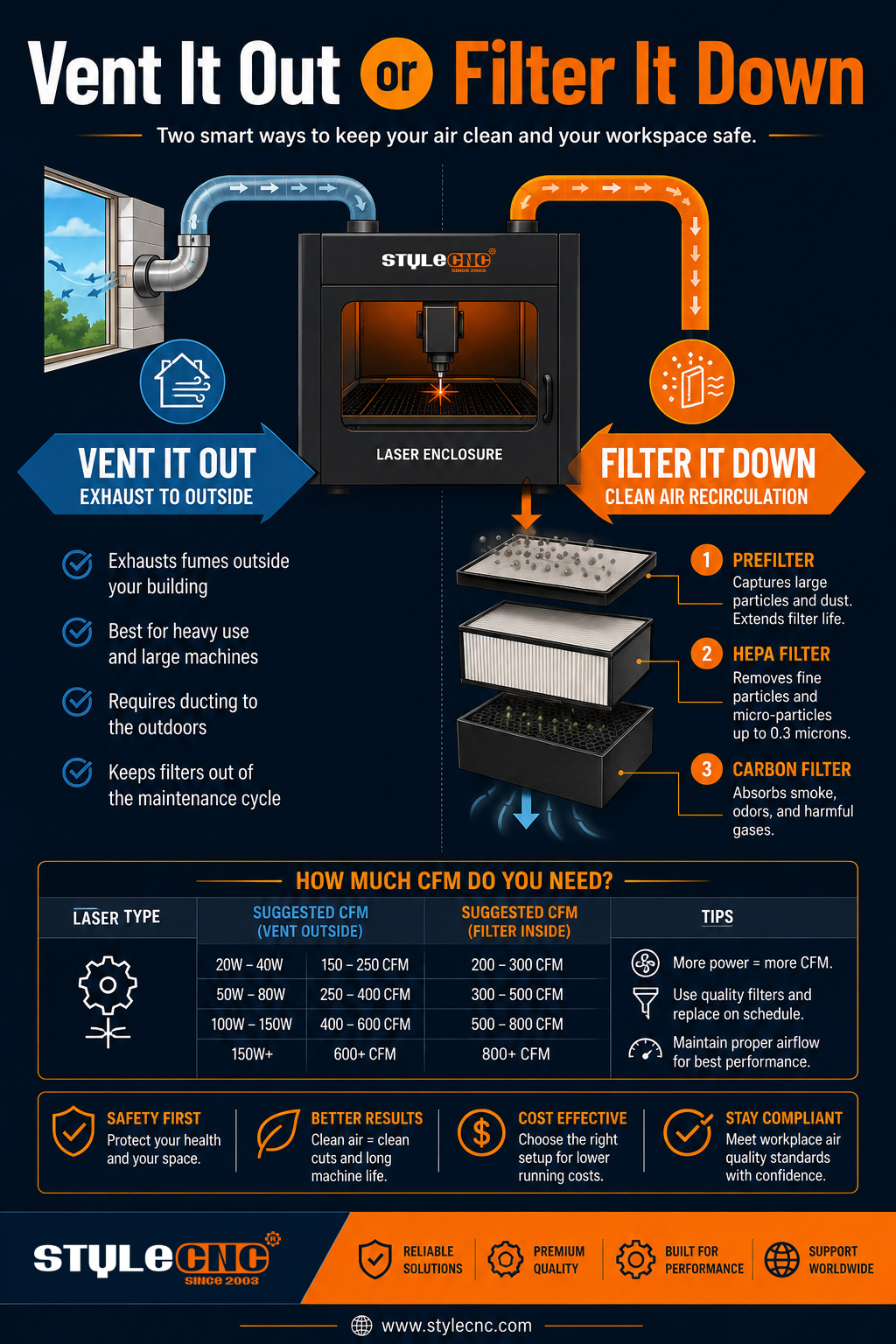
Route one sends everything outdoors through a sealed duct. Route two captures everything in stages inside a unit such as the air filter fume extractor for laser machines, then returns cleaned air to the room.
| Attribute | Ducted Exhaust Outdoors | Filtered Fume Extractor |
| Measurement | Typical airflow 200-1000 CFM inline fans | Typical airflow 100-500 CFM rated units |
| Upfront cost | Low: fan, duct, wall plate | Higher: multi-stage filtered unit |
| Running cost | Fan electricity only | Filter media on a schedule |
| Placement | Needs a wall or window route | Sits anywhere near the machine |
| Odor control | Smell exits the building | Carbon stage captures it indoors |
| Best fit | Fixed shops with outdoor access | Rentals, offices, cold climates |
Many shops run both: ducted exhaust as the daily workhorse, a filtered unit for winter nights and late hours.
How Much Airflow: Sizing the Fan
Size from enclosure volume, not laser wattage. The goal is a complete air change every few seconds, with gentle negative pressure holding smells inside the cabinet.
| Machine Class | Typical Enclosure | Minimum Airflow | Duct Diameter |
| Measurement | interior volume, cubic feet | CFM, with m³/h in brackets | mm, with inches in brackets |
| Desktop diode enclosure | 8-15 | 100-180 (170-300 m³/h) | 100 (4 in) |
| Desktop CO2 cabinet | 10-20 | 150-250 (250-420 m³/h) | 100 (4 in) |
| Cabinet CO2, 60W to 100W | 25-45 | 300-500 (510-850 m³/h) | 150 (6 in) |
| Fiber marker with hood | 4-8 | 80-150 (140-250 m³/h) | 75-100 (3-4 in) |
| Large flatbed or dual head | 60 and up | 600-1000 (1020-1700 m³/h) | 200 (8 in) |
Ratings on fan boxes assume zero duct. Real runs with bends deliver less, so buy the next size up whenever the route is long.
Give the room a makeup air path and confirm flow with a smoke test at the lid. For production volumes, NIOSH exposure resources are the reference worth bookmarking.
Key Numbers Worth Remembering
• Fine laser smoke particulate sits well below 2.5 microns, the size fraction that reaches deep lung tissue.
• A single 90 degree elbow can cost a duct run a noticeable share of its rated airflow, so plan straight lines first.
• Carbon stages usually give out before HEPA stages; smell breakthrough is the change signal.
• Negative pressure inside the enclosure is the target: air should leak inward, never outward.
• A complete enclosure air change every few seconds keeps the viewing window clear and the optics cleaner for longer.
Questions Operators Actually Ask
What setup works in a rented apartment with no window mods?
A sealed enclosure feeding a filtered extractor with a generous carbon stage. Nothing penetrates a wall, nothing bothers the landlord, and filter media becomes your only running cost.
Can a window box fan handle a small diode enclosure?
It moves air but has almost no static pressure, so a few duct bends kill it. A rated inline duct fan at the same price outperforms it through any real run.
Where does the replacement air come from?
From the room, so give it a path. Crack a door or add a vent; a sealed room starves the fan, and the airflow number printed on the box never arrives.
Common Mistakes That Undo the Fan
• Running a powerful exhaust fan with no makeup air path into the room.
• Venting into an attic, crawl space, or attached garage.
• Letting flex duct sag through five bends on the way to a window.
• Sizing the fan by laser wattage instead of enclosure volume.
• Waiting for smell before changing the carbon stage.
• Cutting PVC or vinyl just once to finish a rush job.
• Ignoring lid seals; a leaky enclosure beats the best fan.
• Treating odor as the hazard while invisible fine particulate drifts.
Ventilation Setup Checklist
✓ Choose the route first: ducted outdoors, or filtered recirculation.
✓ Size airflow from enclosure volume, not laser wattage.
✓ Keep duct runs short, straight, and smooth-walled.
✓ Provide a makeup air path into the room.
✓ Smoke-test the enclosure and confirm negative pressure.
✓ Log filter hours and change carbon before breakthrough.
✓ Ban PVC, vinyl, and unknown plastics from the material shelf.
Frequently Asked Questions
Is engraving wood actually harmful, or just smelly?
Both. Wood smoke carries fine particulate small enough to reach deep lung tissue, plus aldehydes from the burn. One job leaves a smell; years of unvented jobs leave a respiratory history. Treat plain pine with the same extraction discipline as any plastic.
Why does my extractor still smell with fresh filters?
Odor breakthrough usually means the carbon stage is saturated or air is bypassing a bad seal. Check gaskets and filter order first: prefilter, then HEPA, then carbon. Carbon exhausts long before HEPA does, so on smelly materials it often needs changing twice as often.
Can I vent into the garage or attic instead of outside?
No. Both spaces leak back into the living envelope, so the fumes take a detour and return. Terminate the duct at an outside wall or window plate with a backdraft damper, and keep the run sealed with foil tape rather than cloth duct tape.
How do I know my airflow is actually enough?
Watch the smoke. It should sweep toward the outlet and clear within a few seconds of the beam stopping. Lingering haze, smell escaping the lid, or smoke drifting toward the door all say the fan is undersized or the duct is choking it.
I cut PVC once by accident. How bad is it?
Once will not destroy the machine, but the released gas forms an acid with moisture that pits optics, rails, and lungs alike. Air the space out fully, wipe the interior down, and retire the material. Repeated exposure is where the real damage compounds.
Do fiber metal markers need extraction too?
Yes. Marking vaporizes metal into oxide fume, and coating burn-off adds organics on painted or coated parts. The volumes are smaller, so a compact hood and a modest extractor handle it, but breathing metal fume unfiltered is a welder-grade mistake.
How often do the carbon and HEPA stages need replacing?
Carbon goes by smell: the first hint of odor at the outlet means breakthrough. HEPA goes by pressure drop or hours, often lasting several carbon cycles. Log run hours per material, because one acrylic-heavy month can age filters faster than a quiet quarter.
Does a long duct really hurt performance that much?
Yes. Every elbow and every meter of ridged flex hose adds resistance, and small inline fans lose flow quickly against it. Keep the run short, swap flex for smooth-wall duct where possible, and step up the fan when the route cannot shrink.
Will better ventilation fix the smell on finished parts?
Only partly. Airborne smell leaves with the exhaust, but residue baked onto the workpiece keeps its own odor. Air assist during the job, masking tape on show faces, and an alcohol wipe afterward handle the part; the extractor handles the room.