Why Pricing Strategy Matters More Than Machine Speed
Pricing discipline is the single biggest factor separating profitable CNC shops from those struggling to break even. Forum users on Signs101 and CAMheads consistently report that underpricing is far more damaging than slow production speeds. A shop running at half capacity with healthy margins outperforms a fully loaded shop charging below cost.
Before setting any rate, you need a clear picture of your total cost of ownership. This includes your machine investment, consumable tooling, electricity, workspace overhead, software licenses, and your own labor. Owners evaluating whether to invest can explore how much CNC routers cost to benchmark realistic equipment budgets against projected service revenue.
Hourly Rate Pricing: How It Works
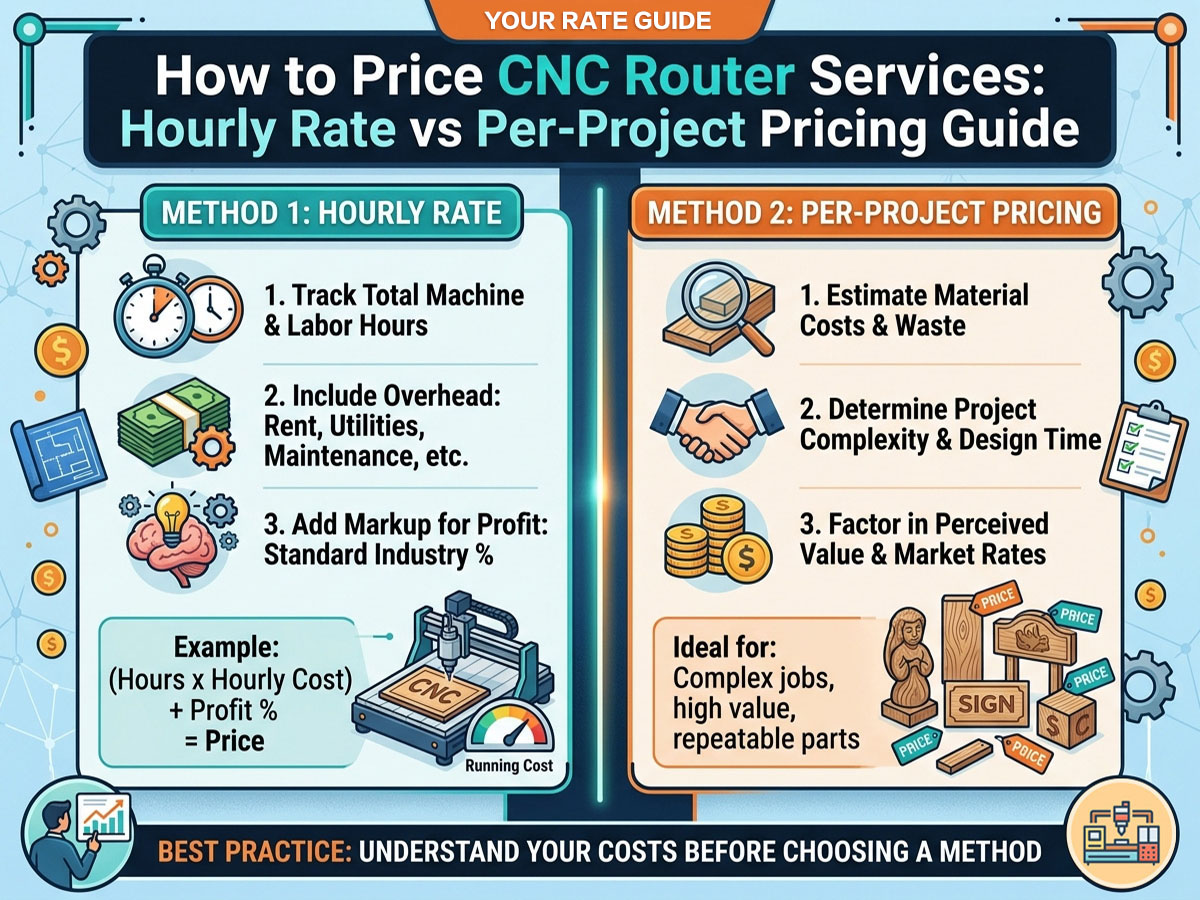
Hourly pricing charges the client based on the total time your machine and operator spend on their job. This includes design time, setup, cutting, and cleanup. It is the most transparent method and works especially well for custom, one-off, or highly variable projects.
Typical CNC Router Hourly Rates
| Shop Type | Hourly Rate Range | Includes | Best For |
|---|---|---|---|
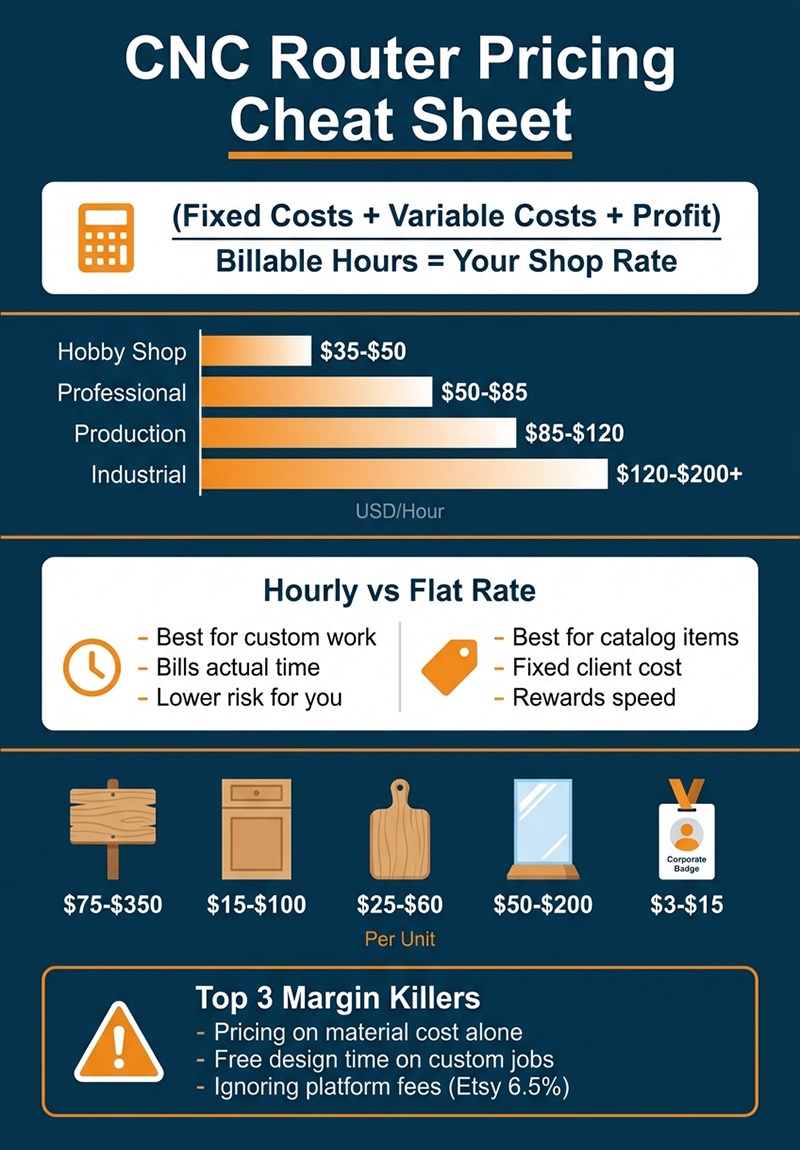
| Hobby/garage shop | $35 - $50/hr | Machine time, basic labor | Simple cuts, small batches |
| Small professional shop | $50 - $85/hr | Machine, labor, design | Signs, furniture parts |
| Mid-size production shop | $85 - $120/hr | Full overhead, software | Cabinetry, architectural |
| Industrial/5-axis facility | $120 - $200+/hr | Premium tooling, QC, metrology | Aerospace, prototyping |
| Measurement | USD per hour | Service components | Job category |
Operators on Router Forums and WOODWEB note that rates vary significantly by geography. Coastal U.S. shops typically charge 20 to 25% more than Midwest operations due to higher overhead costs. When comparing equipment options across regions, understanding the differences between Chinese CNC routers vs American and European models helps you select machinery that supports competitive pricing in your local market.
When Hourly Pricing Works Best
• Custom one-off projects: Jobs where design complexity is unknown upfront make flat-rate quoting risky. Hourly billing protects your margins on unpredictable work.
• Design-heavy commissions: Projects requiring significant CAD/CAM time before any cutting begins. Design hours at $35 to $75/hour should be billed separately from machine time.
• Prototype and R&D work: When clients need iterative cutting with multiple revisions, hourly billing avoids the trap of requoting every change order.
Per-Project Pricing: How It Works
Per-project pricing (also called flat-rate or fixed-price) quotes a single total for the entire job. The client knows exactly what they will pay before work begins. This method requires you to accurately estimate time, materials, and complexity upfront.
Per-Project Formula: (Material Cost + Machine Time x Rate + Design Labor + Overhead Allocation) x 1.25 to 1.35 Profit Margin
When Per-Project Pricing Works Best
• Standardized products: Signs, cutting boards, cabinet parts, and engraved gifts with predictable production times. You know exactly how long each unit takes.
• Repeat and batch orders: Corporate signage runs, wedding favor batches, and wholesale inventory, where you have historical time data from previous jobs.
• E-commerce and retail: Online storefronts on Etsy, Shopify, or Amazon require fixed visible prices. Shoppers exploring profitable laser engraved products expect clear per-item pricing without hourly surprises.
Hourly vs Per-Project: Side-by-Side Comparison
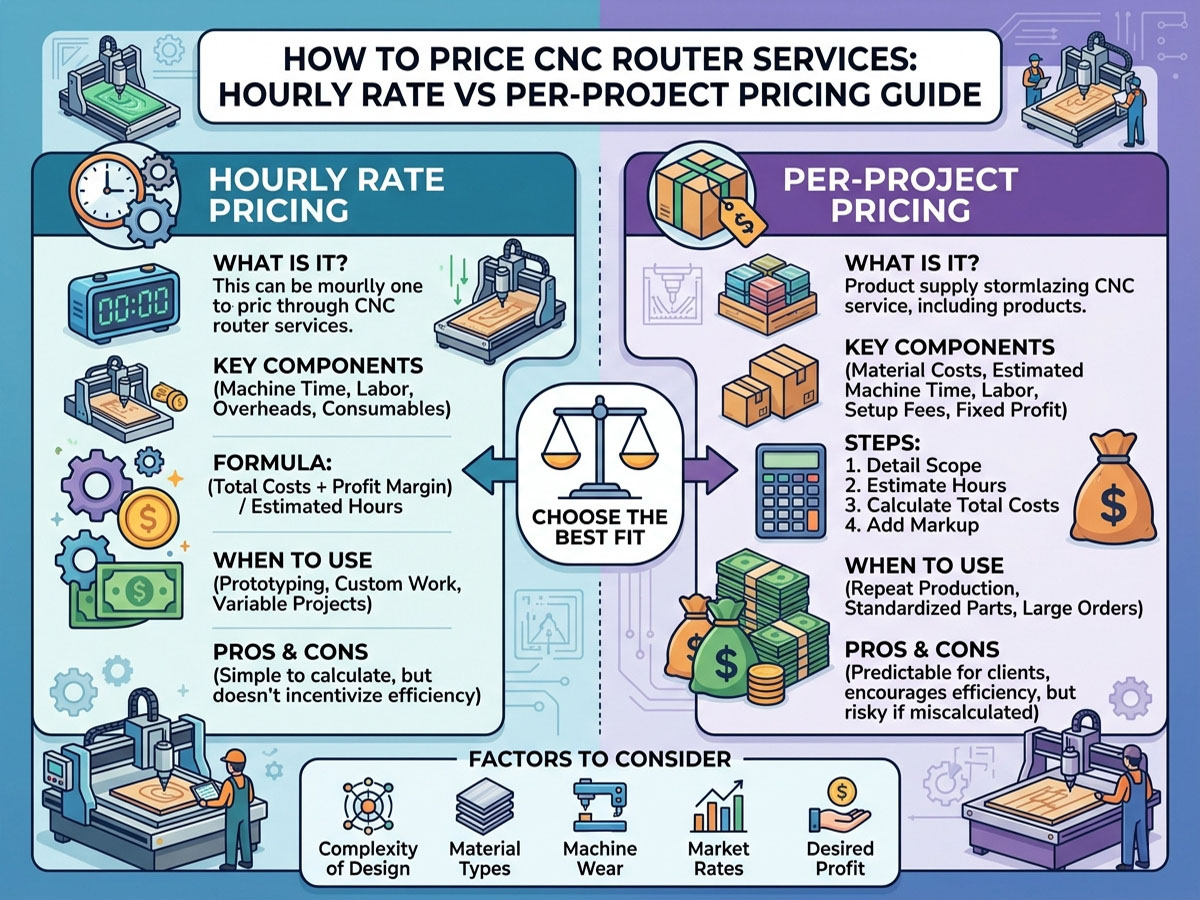
| Factor | Hourly Rate | Per-Project (Flat Rate) |
|---|---|---|
| Revenue predictability | Variable, depends on actual time | Fixed and predictable per job |
| Client transparency | Can feel open-ended to buyers | Clear upfront cost builds trust |
| Risk of undercharging | Low, you bill actual time spent | High if you underestimate scope |
| Best job types | Custom, complex, prototype work | Standardized, repeat, retail items |
| Profit margin control | Moderate, limited by clock | High, rewards efficiency gains |
| Scaling potential | Limited by billable hours | High, batch processing multiplies margins |
| Design fee handling | Bundled into hourly total | Billed separately or absorbed |
| Measurement | USD per hour of operation | USD per completed deliverable |
The most successful CNC businesses use both models strategically. Forum contributors on Signs101 and LumberJocks recommend quoting flat rates for your core product catalog while reserving hourly billing for custom requests outside your standard offerings.
How to Calculate Your True Shop Rate
Your shop rate is the minimum hourly figure you must charge to cover all costs and generate profit. Every pricing decision flows from this number. Shop owners considering whether CNC ownership fits their operation can weigh the decision by reviewing whether it is worthwhile for small businesses to buy CNC machines before committing to a rate structure.
Step 1: Total your monthly fixed costs
• Machine payment or depreciation allocation.
• Workspace rent, insurance, and utilities.
• Software licenses (CAD/CAM, nesting, ERP).
• Your base salary or owner draw.
Step 2: Estimate monthly variable costs
• Tooling and bit replacement (average $200 to $500/month for active shops).
• Electricity ($50 to $200/month depending on machine size).
• Maintenance consumables (lubricants, dust collection filters, vacuum seals).
Step 3: Determine billable hours
Estimate the realistic number of hours your machine will be cutting and earning revenue each month. At 60 to 80% utilization on a 40-hour work week, expect roughly 100 to 130 billable machine hours per month.
Step 4: Apply the formula
Shop Rate = (Total Fixed Costs + Total Variable Costs + Target Profit) / Billable Hours per Month
If your total monthly costs are $6,000 and you target $2,000 in monthly profit across 120 billable hours, your minimum shop rate is approximately $67 per hour. Any job priced below this number loses money regardless of how busy the machine stays.
Pricing Real-World CNC Products: Quick Reference
These ranges reflect actual market data from forum discussions on CAMheads, Signs101, Router Forums, and Reddit r/CNC communities. Operators planning to enter the sign-making vertical can explore a detailed roadmap for starting a CNC sign making business to align pricing with proven demand.
• Custom wood signs (12x24 to 24x48): $75 to $350 depending on material, complexity, and finishing. V-carved text signs at the low end, 3D relief carved pieces at the high end.
• Cabinet parts (nested, per sheet): $15 to $35 per sheet for basic cutting. Full processing with edge banding coordination commands $50 to $100 per sheet.
• Laser engraved cutting boards: $25 to $60 per board. Batch production of 10 or more boards reduces per-unit cost and increases margin significantly.
• Acrylic signage and displays: $50 to $200 per piece. Premium pricing applies for LED-lit edge applications and multi-layer assemblies.
• Corporate logo engraving (batch): $3 to $15 per unit at volume. Minimum order thresholds of $150 to $250 protect against unprofitable small runs.
• 3D relief carving and art pieces: $200 to $1,000+. These projects command premium pricing due to extended machine time and specialized programming expertise.
Common Pricing Mistakes That Destroy Margins
Experienced CNC machine operators across Reddit, WOODWEB, and Signs101 warn against these recurring errors. Understanding your laser engraver costs and earning potential, and accurately forecasting demand prevents most of these pitfalls.
✓ Pricing based on material cost alone without factoring machine time, overhead, or design labor
✓ Forgetting to charge setup fees for one-off jobs that require custom fixturing or file preparation
✓ Using competitor prices as your baseline without knowing their cost structure or whether they are actually profitable
✓ Giving free design time on custom projects, then absorbing hours of unpaid CAD work
✓ Offering bulk discounts that push per-unit profit below your break-even threshold
✓ Charging the same rate for simple plywood cuts and complex hardwood 3D carvings
✓ Ignoring platform fees (Etsy 6.5%, payment processing 2.9%) when setting online retail prices
✓ Failing to build a 10 to 15% waste buffer into material cost estimates
The Hybrid Approach: Best of Both Models
Most profitable CNC service businesses do not commit exclusively to hourly or per-project pricing. They use a hybrid model that applies the right method to each job type.
• Catalog products at fixed prices: List your standard offerings (signs, plaques, cutting boards, cabinet parts) with clear per-item pricing. These are your bread-and-butter revenue generators.
• Custom work at hourly + materials: Quote custom commissions at your shop rate plus materials with a 25% markup. Communicate estimated hours upfront so clients know the expected range.
• Design fees billed separately: Charge $35 to $75 per hour for CAD/CAM work, separate from machine time. This protects your most valuable intellectual labor.
• Minimum job charges: Set a floor of $50 to $150 per job to prevent small orders from consuming disproportionate setup time. Forum users on CAMheads and Signs101 universally recommend minimum charges.
• Rush and priority surcharges: Add 25 to 50% for expedited turnaround. Clients who need next-day delivery are willing to pay for prioritization.
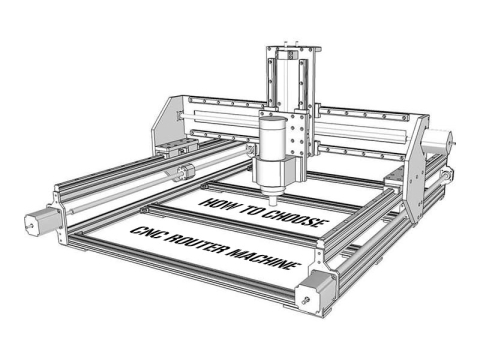
Selecting the right machine for your pricing model matters as much as the pricing itself. Owners exploring equipment options benefit from guidance on how to choose the right CNC router to match production capability with revenue goals. For those evaluating complementary product lines, reviewing the top laser cutting products to sell on Amazon and Shopify can identify high-margin items worth adding to your catalog.
Frequently Asked Questions
What is a good hourly rate to charge for CNC router work?
Most professional CNC shops charge between $50 and $120 per hour depending on machine capability, complexity, and geographic location. Garage-based hobby shops start around $35 per hour, while industrial 5-axis operations can exceed $150 per hour.
Should I charge separately for design and setup time?
Yes. Design and programming time at $35 to $75 per hour should be billed independently from machine cutting time. Bundling design into your cutting rate undervalues your most skilled labor and compresses margins on complex projects.
How do I set a minimum job charge?
Calculate the cost of your average setup time (loading material, zeroing the machine, running a test cut) and add a small profit buffer. Most shops set minimums between $50 and $150 to ensure even the smallest jobs contribute positively to overhead coverage.
Is per-minute pricing better than per-hour for laser engraving?
Per-minute pricing ($1 to $5 per minute) offers more granular accuracy for short laser engraving jobs. It prevents undercharging on quick 10-minute tasks where a full hourly rate feels excessive to clients, but a flat rate might undervalue your time.
How often should I review and adjust my pricing?
Review pricing every three to six months. Material costs, electricity rates, tooling expenses, and local market conditions shift regularly. Shops that set prices once and never revisit them gradually erode margins without realizing it.
Should I offer volume discounts on batch CNC orders?
Volume discounts of 5 to 20% are appropriate for large batch orders because setup time is amortized across more units. Always verify that the discounted per-unit price still exceeds your break-even cost before committing to a volume rate.
Final Thoughts
Pricing CNC router and laser services is not a guessing game. It is a calculation grounded in your actual costs, realistic utilization, and the value you deliver to your market. Whether you lean toward hourly billing, per-project quotes, or a hybrid approach, the foundation remains the same: know your shop rate, protect your margins, and never undervalue the expertise behind every cut.