EXECUTIVE SUMMARY
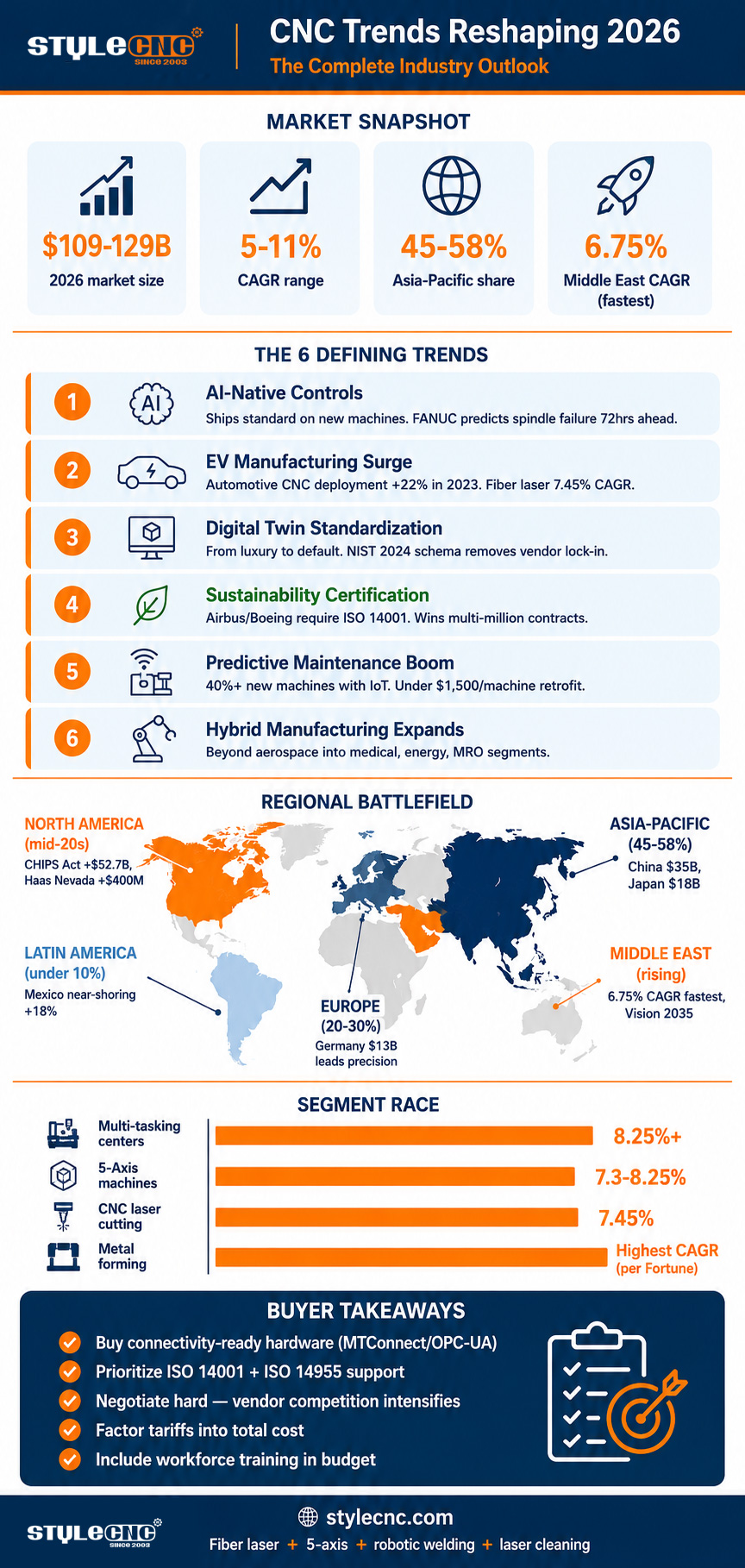
▸ Market size: Global CNC machine tool market reaches roughly USD 109 to 129 billion in 2026 depending on scope, growing at 5 to 11 percent CAGR across most forecasts.
▸ Regional leader: Asia-Pacific holds 45 to 58 percent share, with China alone at roughly USD 35 billion. Middle East is the fastest-growing region at 6.75 percent CAGR.
▸ Growth segments: 5-axis machines (7.3 to 8.25 percent CAGR), CNC laser cutting (7.45 percent CAGR), and multi-tasking turn-mill centers lead segment growth.
▸ Demand drivers: Electric vehicles, semiconductors, aerospace re-equipment, reshoring, and Middle East industrial diversification.
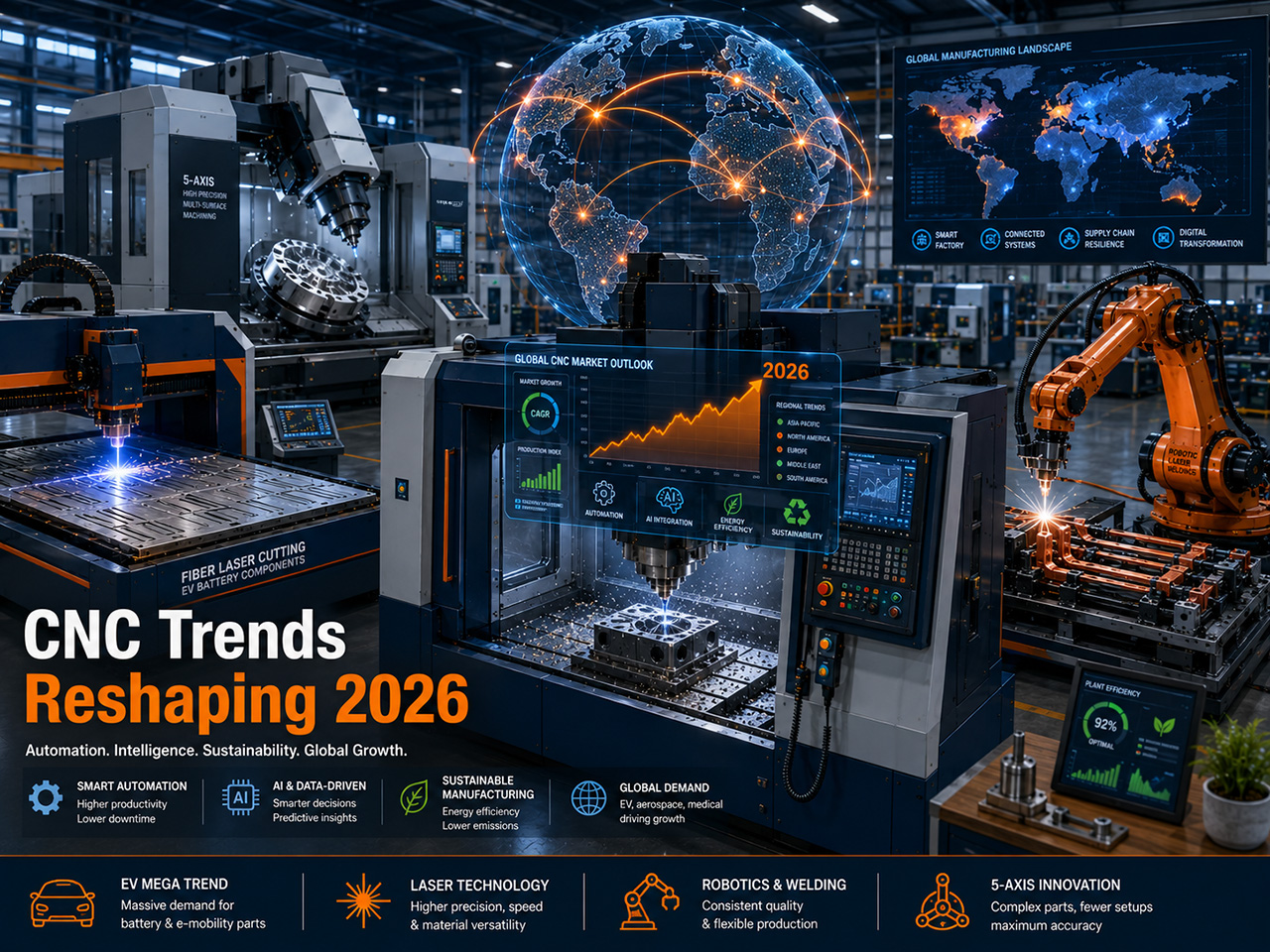
▸ Six defining trends: AI-native controls, EV manufacturing surge, digital twin standardization, sustainability certification, predictive maintenance retrofit boom, and hybrid manufacturing beyond aerospace.
The CNC machining industry entered 2026 in the strongest structural position of the decade. Order books at major builders are backed by aerospace re-equipment programs, electric vehicle supply chains scaling to full production, semiconductor fab construction fueled by government incentive programs, and reshoring of manufacturing capacity back to North America and Europe. This report covers the state of the industry, the six defining trends reshaping the sector, regional and segment performance, buyer implications, and how STYLECNC fits into the 2026 landscape.
The State of CNC Manufacturing Entering 2026
The global CNC machine tools market entered 2026 valued between USD 109 billion (Precedence Research) and USD 129 billion (industry consensus estimates), depending on segment scope and definition. Growth forecasts range from 4.5 percent CAGR (The Business Research Company) to 11.10 percent CAGR (Fortune Business Insights), with most projections clustering between 5 and 10 percent through 2030.
The wide forecast range reflects real underlying dynamics. Different research firms include or exclude parts, accessories, services, and adjacent categories like grinding machines, EDM, and additive systems. The aggregate signal from all major reports is consistent: the industry is growing significantly faster than global GDP, and the growth is being driven by structural shifts in the customer base rather than cyclical replacement demand.
Three structural drivers underpin the 2026 outlook. First, electric vehicle production continues to scale globally, with CNC deployment in automotive rising 22 percent in 2023 alone according to Maximize Market Research. Second, government incentive programs including the U.S. CHIPS and Science Act (USD 52.7 billion) and Saudi Vision 2035 are underwriting massive industrial construction that embeds CNC cells at scale. Third, reshoring has moved from talking point to measurable trend, with 38 percent of U.S. manufacturers reporting they have shifted part of their production back from Asia.
The competitive landscape has not fundamentally shifted since 2024. FANUC, Yamazaki Mazak, DMG MORI, Okuma, JTEKT, Makino, Haas Automation, Amada, Doosan, and Trumpf remain the ten largest builders by revenue. What has changed is the intensity of competition among these builders and the pressure from second-tier manufacturers, particularly from China and other Asian markets, on the price-to-performance ratio at the mid-tier segment. Buyers with USD 100,000 to 500,000 budgets have significantly more options in 2026 than they did five years ago.
Supply chain constraints from earlier in the decade have largely resolved. Semiconductor availability for controllers, servo drives, and sensor modules has normalized. Steel and aluminum prices have stabilized. Logistics costs remain elevated relative to pre-pandemic norms but have become predictable. The result is stable lead times of 3 to 9 months on most new machine orders, with premium and highly customized configurations extending to 12 to 18 months.
The 6 Biggest CNC Trends Reshaping 2026
QUICK ANSWER
The biggest CNC trends in 2026 are: (1) AI-native control systems shipping standard on new machines, (2) explosive fiber laser demand from EV battery and motor production, (3) digital twin standardization from luxury to default, (4) sustainability certifications becoming procurement gate-keepers, (5) predictive maintenance retrofits going mainstream, and (6) hybrid manufacturing spreading beyond aerospace into medical, energy, and MRO.
Each trend is grounded in published 2026 industry data. The trends are ranked by the size of business impact expected across the CNC ecosystem, from broadest at the top to more specialized at the bottom.
TREND #1: AI-Native CNC Control Systems Ship Standard
Key stat: FANUC cloud dashboard predicts spindle failure 72 hours ahead with 18 to 22 percent downtime reduction at automotive beta sites.
AI is moving from optional software layer to embedded standard. Siemens SINUMERIK ONE, DMG MORI CELOS, FANUC CNC Guide, and Heidenhain TNC7 now ship with kinematic models and predictive analytics baked in. What used to require a separate third-party MES license now comes with the controller. For CNC buyers, the practical implication is that AI-driven toolpath optimization, adaptive feedrate control, and thermal compensation are no longer premium features. They are the baseline expected on any machine purchased in 2026.
TREND #2: EV Manufacturing Drives Explosive Fiber Laser Demand
Key stat: CNC deployment in automotive rose 22 percent in 2023 driven by EV battery and motor production; CNC laser cutting projected at 7.45 percent CAGR through 2031.
Electric vehicle production has become the single largest new demand driver for fiber laser cutting and welding equipment outside of traditional sheet-metal fabrication. Battery pack housings, module casings, busbars, and body-in-white panels all use fiber laser processes at scale. Robotic laser welding of cell interconnects has become the defining process for EV battery assembly. Tier 1 and Tier 2 EV suppliers globally are placing multi-machine orders, with automotive-grade fiber laser cutters and welding robots representing the fastest-growing single equipment category.
TREND #3: Digital Twin Standardization Across Machine Tiers
Key stat: Siemens and DMG MORI embed kinematic models inside SINUMERIK ONE; NIST 2024 sensor schema standardizes vibration, temperature, and axis tags across builders.
Digital twin capability has moved from luxury option on premium machines to expected standard on mid-tier equipment. HEIDENHAIN Digital Twin Service, Siemens Run MyVirtual Machine, and Fanuc CNC Guide all ship with the machine rather than as a separate purchase. The NIST 2024 schema and MTConnect 2.3 standardization mean digital twins from different vendors now speak the same data language, which has removed vendor lock-in as an adoption barrier and expanded the addressable retrofit market significantly.
TREND #4: Sustainability Becomes a Procurement Gate-Keeper
Key stat: Aerospace primes now require ISO 14001; documented job shops have won multi-million-dollar contracts through TRUE Zero Waste certification.
Sustainability has moved from marketing to procurement requirement. Airbus, Boeing, and other aerospace primes require ISO 14001 certification from Tier 1 suppliers. Medical device customers pay premiums for bio-compatible processes. European exporters increasingly need ISO 50001 energy management certification. The ISO 14955 machine tool energy measurement standard is being invoked in purchase specifications, making energy data sheets a routine part of the quote process. Sustainability is now a commercial lever, not a cost.
TREND #5: Predictive Maintenance Democratization
Key stat: Over 40 percent of new CNC machines sold in 2024 shipped with IoT-enabled interfaces; low-cost retrofit sensors have brought predictive maintenance within reach of small shops.
Predictive maintenance is no longer only for Tier 1 producers. The combination of low-cost sensors (spindle current, vibration accelerometers, temperature RTDs) and low-cost edge gateways has driven per-machine monitoring costs below USD 1,500 in most configurations. Shops with as few as five machines are now deploying predictive programs that would have been impractical two years ago. Machine builders are increasingly shipping sensor mounts and data output as standard rather than retrofit.
TREND #6: Hybrid Manufacturing Beyond Aerospace
Key stat: Hybrid additive-subtractive systems are expanding from aerospace into medical, energy, and MRO segments; single-machine systems remain USD 1 to 2 million.
Hybrid manufacturing combining additive deposition with subtractive machining has expanded outside its traditional aerospace stronghold. Medical device makers are using hybrid systems for patient-specific implants. Energy sector MRO operations use hybrid deposition to repair worn high-value components including turbine blades, gearbox housings, and mold cavities. The economics work wherever material is expensive, geometry is complex, and volume is low to medium.
Regional Market Analysis: Where Growth Is Happening
Regional distribution of CNC market activity in 2026 reflects the underlying industrial base of each region. Asia-Pacific dominates absolute volume, North America grows through reshoring and government incentives, Europe leads high-precision segments, and the Middle East posts the fastest percentage growth.
| Region | 2026 Share | Growth Rate | Key Drivers |
|---|---|---|---|
| Asia-Pacific | 45 to 58 percent | Steady dominant | China (USD 35B), Japan (USD 18B), India (USD 2.6B). Automotive, electronics, aerospace |
| North America | Mid-20 percent | Accelerating | CHIPS Act (USD 52.7B fab investment), Haas USD 400M Nevada expansion, Mexico near-shoring +18 percent CNC imports |
| Europe | 20 to 30 percent | Steady | Germany (USD 13B), precision engineering, sustainability retrofits qualify for tax write-offs |
| Middle East | Small but rising | 6.75 percent CAGR (fastest) | Saudi Vision 2035 targeting 25 percent manufacturing GDP share, UAE and Egypt industrial parks |
| Latin America | Under 10 percent | Emerging | Mexico near-shoring flow-through, Brazil aerospace and automotive base |
The Asia-Pacific dominance is worth explaining. Beyond the China manufacturing base, Japan remains the technology leader in premium machine tools with FANUC, Mazak, DMG MORI (Japanese-German joint venture), Okuma, JTEKT, and Makino all headquartered in the region. India represents the fastest-growing large market by percentage as its automotive and aerospace supply chains scale. South Korea contributes advanced electronics and semiconductor CNC capability.
North American growth in 2026 is genuinely accelerating rather than smoothly extending. The Haas Automation USD 400 million Nevada complex adds 1.4 million square feet of domestic production capacity. Intel, TSMC, and Samsung fab builds represent over USD 100 billion in construction, each project embedding hundreds of CNC cells. Mexico near-shoring has driven an 18 percent year-on-year increase in CNC imports as production returns closer to end markets.
European growth is steady rather than dramatic, with the region maintaining its lead in high-value precision segments. Germany accounts for approximately USD 13 billion in 2026 and remains the global leader in precision engineering and grinding machines. Carbon-neutral regulatory pressure is accelerating retrofit demand for energy-efficient systems, with three-year tax write-offs available for single-pump coolant systems saving 30 percent electricity. Europe also leads in early adoption of digital twin and predictive maintenance standards through ISO working groups.
Segment Performance: Where the Money Is Flowing
Within the broader CNC market, segment performance varies significantly by machine type and axis count. The table below summarizes 2026 outlook for the primary segments.
| Segment | Growth Rate (CAGR) | 2026 Context and Drivers |
|---|---|---|
| 5-Axis Machines | 7.3 to 8.25 percent | Aerospace 70 percent+ 5-axis adoption, mold-die shops upgrading, medical device growth |
| CNC Laser Cutting | 7.45 percent through 2031 | EV battery cases and aerospace skins drive burr-free cut demand |
| Multi-Tasking Turn-Mill | 8.25 percent+ | Done-in-one machining, medical and turbine complex geometries |
| CNC Lathes | Steady, largest segment | Automotive volume, USD 32.82 billion in 2024. Foundational segment |
| CNC Milling | Strong growth | Automotive engine block work, EV motor housings |
| Metal Forming | Highest CAGR (per Fortune) | EV structural parts, aerospace panels |
| EDM and Grinding | Steady, specialized | Mold-die precision, tool and cutter sharpening |
| Additive/Hybrid Systems | Expanding out of aerospace | Medical, energy MRO, mold conformal cooling |
The clear pattern across segments is that specialized precision segments (5-axis, laser cutting, multi-tasking) are growing significantly faster than commodity segments. This reflects the underlying customer shift toward complex parts, tight tolerances, and consolidated operations, which are all forces pointing away from single-purpose machines and toward integrated multi-function platforms.
What This Means for CNC Buyers in 2026
The trends and market data resolve into a small number of practical takeaways for shops evaluating CNC purchases in 2026.
First, buy connectivity-ready hardware. Any new machine purchased in 2026 should ship with MTConnect or OPC-UA output, integrated sensor mounts, and controller architecture that supports digital twin software. The incremental cost is negligible; the retrofit cost of adding connectivity later is significant.
Second, prioritize sustainability certification support. Machines with published energy data sheets under ISO 14955 make certification faster and cheaper. Customer procurement requirements are increasingly ISO 14001 and ISO 50001 based, and machines that support these certifications save months of documentation work.
Third, expect vendor competition to intensify. With Asian, European, and North American builders all expanding capacity, buyers have more negotiating leverage in 2026 than in any recent year. Multi-machine orders in particular have significant room for price negotiation, extended warranty inclusion, and integration support.
Fourth, tariff and trade policy is a real risk factor. Cross-border supply chains for spindles, servo motors, linear guides, and controllers are subject to ongoing tariff volatility. Buyers should factor supplier country of origin into total cost of ownership calculations and confirm long-term parts availability for critical machines.
Fifth, workforce readiness matters more than in the past. Modern CNC machines with AI controls, digital twin integration, and predictive maintenance sensor arrays require operators and programmers with a different skill mix than the previous generation. Buyers evaluating multi-machine investments should include training and hiring in the total cost calculation, and confirm that machine builder onboarding programs match the actual gap between current staff capability and required skills.
STYLECNC in the 2026 CNC Landscape
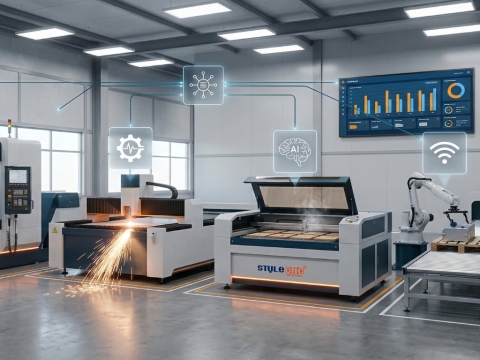
STYLECNC operates as an established Asian CNC manufacturer serving global customers across the trends identified in this report. The company builds fiber laser cutters at scale for EV battery and body-in-white production, ATC CNC routers for panel furniture and industrial machining, 5-axis machining platforms for aerospace and mold work, robotic laser welding systems for automotive assembly, and laser cleaning equipment for chemical-free surface preparation.
For the AI-native and digital twin trend, STYLECNC industrial machines ship with modern controller architecture that integrates cleanly with third-party MES and digital twin software from Siemens, HEIDENHAIN, and other major providers. For the EV manufacturing surge, the fiber laser cutting machine catalog and laser welding machine catalog cover the specific product configurations required for battery pack, motor, and body-in-white production.
For the sustainability trend, the laser cleaning machine catalog replaces chemical processes with dry laser cleaning, and the intelligent nesting configurations in the furniture production line catalog push material yield toward the 85 to 95 percent range that industry benchmarks now expect. For the predictive maintenance retrofit boom, STYLECNC industrial machines ship with sensor mounts and data output as standard rather than special-order.
For the 5-axis and hybrid manufacturing trends, the 5-axis CNC machine catalog and multi-tasking machining configurations support the specialized precision segments that continue to outgrow the broader market. Across all product lines, STYLECNC serves customers in the Asia-Pacific, North American, European, and increasingly Middle Eastern markets that are driving 2026 CNC demand.
Glossary: 2026 CNC Industry Terms
Use this reference when reviewing industry reports, evaluating suppliers, or discussing 2026 trends with procurement teams.
| Term | Definition |
|---|---|
| CAGR | Compound annual growth rate. Standard metric for multi-year market forecasts. |
| Reshoring | Return of manufacturing production from offshore locations back to the domestic market. |
| Near-shoring | Relocation of manufacturing to nearby countries rather than domestic return. Mexico for U.S. is the leading example. |
| CHIPS Act | U.S. CHIPS and Science Act (2022). USD 52.7 billion federal fund to expand domestic semiconductor manufacturing. |
| MTConnect | Open communications protocol for CNC machine data exchange. MTConnect 2.3 standardizes edge gateway data. |
| OPC-UA | Open Platform Communications Unified Architecture. Industrial data exchange standard widely used for machine integration. |
| Multi-tasking center | CNC machine combining turning, milling, and often drilling in a single setup. Fastest-growing precision segment. |
| Body-in-white (BIW) | Assembled vehicle body structure before painting, dominated by welded steel and aluminum panels. |
| Done-in-one machining | Producing a complete finished part in a single machine setup, eliminating re-fixturing and handling. |
| ISO 14955 | International standard for machine tool energy consumption measurement. Increasingly required in procurement. |
Frequently Asked Questions
How big is the global CNC machining market in 2026?
The global CNC machine tools market is valued between USD 109 billion (Precedence Research) and USD 129 billion (industry consensus) in 2026, depending on segment scope. Fortune Business Insights projects growth to USD 251.61 billion by 2034 at 11.10 percent CAGR. Mordor Intelligence projects USD 105.7 billion by 2031 at 5.96 percent CAGR. The wide range reflects different definitions of what counts as a CNC machine tool, but every major report agrees the market is growing significantly faster than global GDP.
Which region dominates CNC machine tool production?
Asia-Pacific dominates global CNC production with 45 to 58 percent share depending on the source, with China alone reaching approximately USD 35 billion in 2026. China, Japan, South Korea, and Taiwan collectively produce most of the world's premium machine tools. Japan houses FANUC, Mazak, Okuma, JTEKT, and Makino. Middle East is the fastest-growing region at 6.75 percent CAGR through 2031.
What is driving the surge in CNC laser cutting demand?
Electric vehicle battery pack production is the primary 2026 driver. Battery housings, module casings, busbars, and body-in-white panels all require fiber laser cutting at scale. CNC laser cutting is projected at 7.45 percent CAGR through 2031 according to Mordor Intelligence, with EV battery cases and aerospace skins the two largest new demand pools. Traditional sheet metal fabrication continues but is no longer the growth engine.
How is reshoring affecting CNC machine purchases?
Reshoring has moved from talking point to measurable trend. Approximately 38 percent of U.S. manufacturers reported shifting part of their production back from Asia in 2024. Mexico near-shoring has driven an 18 percent year-on-year jump in CNC imports. Haas Automation is opening a USD 400 million Nevada production complex in late 2026. The reshoring wave is real and is generating multi-machine capital orders that were not part of the market a decade ago.
Are tariffs a real concern for CNC buyers in 2026?
Yes, according to industry analysts including GII Research. Tariffs on imported spindles, servo motors, linear guides, controllers, and high-precision mechanical components are directly affecting machine pricing. Manufacturing hubs in Asia-Pacific, particularly China, Japan, and South Korea, along with Europe, are most affected due to cross-border supply chains. Small and medium manufacturers report delayed capital investments and increased total cost of ownership as tariffs pass through.
What CNC certifications will customers require in 2026?
The 2026 procurement gate-keeper certifications are ISO 14001 for environmental management, ISO 9001 for general quality management, IATF 16949 for automotive suppliers, ISO 13485 for medical device parts, and AS9100 for aerospace. ISO 50001 for energy management and ISO 14955 for machine tool energy measurement are emerging as customer requirements, particularly for European exporters and companies serving corporate ESG-reporting customers.
The Bottom Line
2026 is not a routine year for the CNC industry. Structural demand from EVs, semiconductor construction, aerospace re-equipment, and reshoring is running simultaneously with technology transitions in AI, digital twins, sustainability certification, and predictive maintenance. Buyers who move deliberately on the trends identified in this report position themselves for the next five years. Buyers who wait find themselves competing for machinery inventory in a market where lead times are extending.
STYLECNC serves the 2026 CNC market with product lines spanning fiber laser cutting, laser welding, 5-axis CNC machining, laser cleaning, and the industrial furniture production line catalog. Contact the STYLECNC team to discuss configurations aligned to the 2026 procurement environment, whether the priority is EV supply chain scale, aerospace precision, sustainability certification support, or predictive maintenance readiness.