Few industrial tools have ever had a marketing department like the laser cleaner's: millions of people have watched rust glide off a hinge in slow motion online. Behind the viral clips sits a genuinely useful machine with real physics, real limits, and a price structure worth understanding before buying. This guide explains how the process selects rust and leaves metal, how pulsed and continuous sources differ, what each power class actually cleans per hour, and how the running costs compare with sandblasting.
The Physics in Plain Terms: Why the Metal Survives
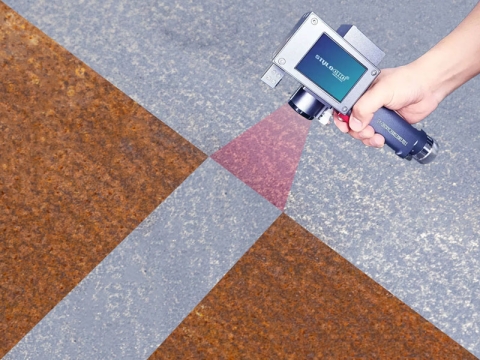
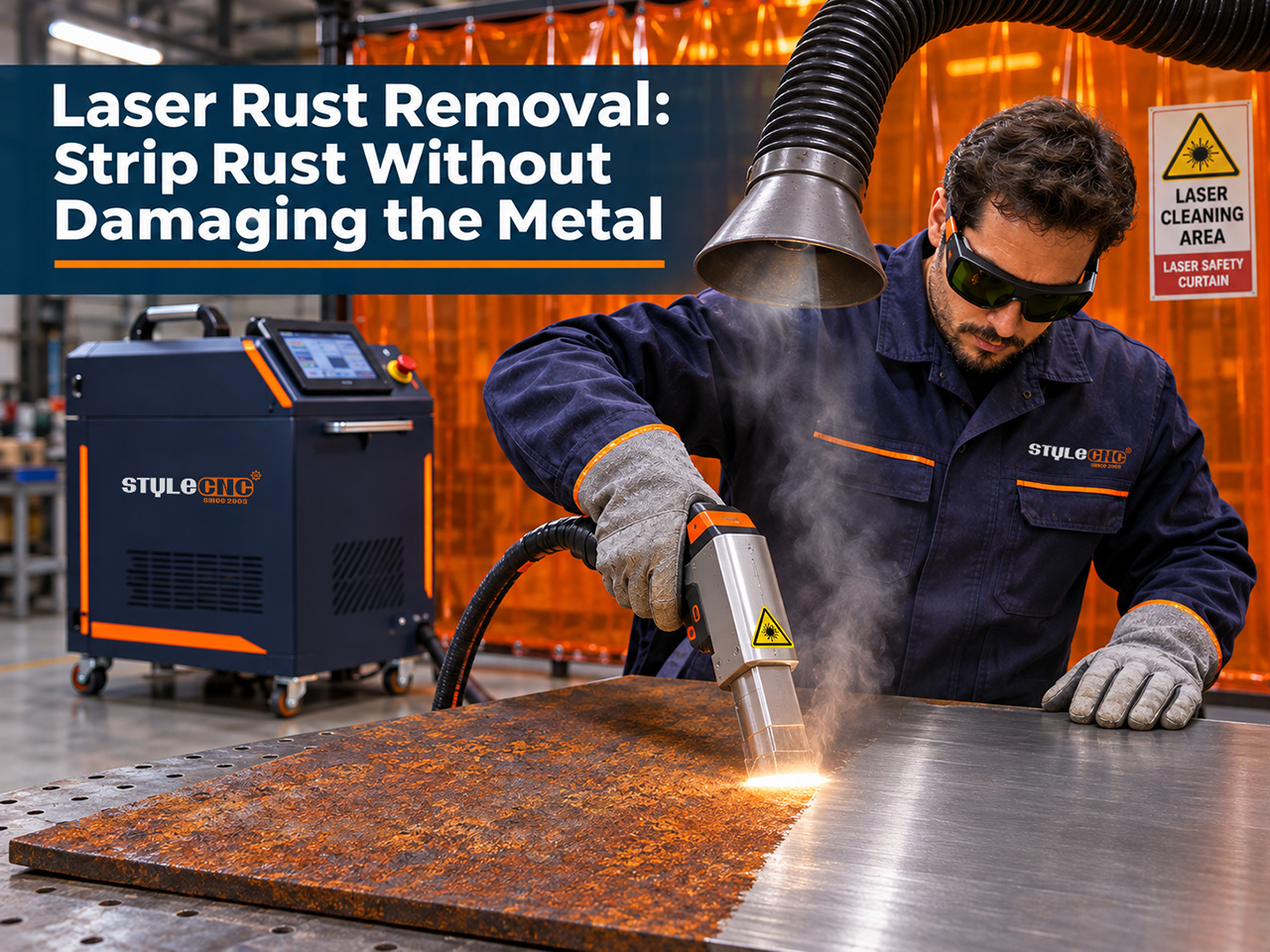
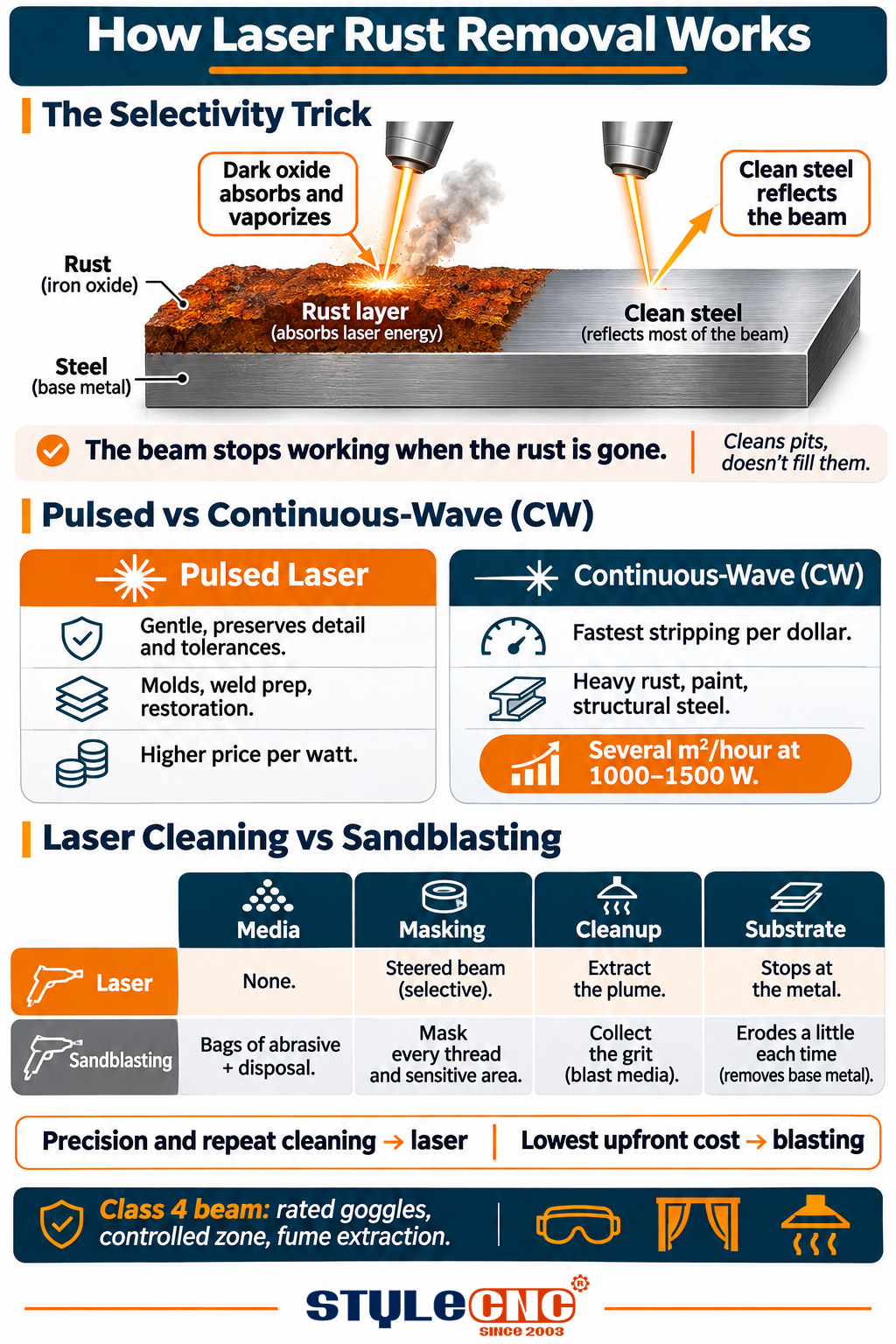
Laser cleaning works because rust and clean steel respond to the beam differently. The dark, porous oxide layer absorbs laser energy strongly and flashes into vapor and fine particles, a process called ablation. The shiny metal beneath reflects most of the same beam, and its ablation threshold is far higher, so when the rust is gone the beam largely stops doing work.
That selectivity is the whole trick. The operator sweeps the scanning head across the surface, the oxide layer disappears line by line, and the base metal keeps its dimensions, which is why the process suits parts where blasting would erode tolerances or chemicals would creep into seams. The same mechanism removes paint, oil residue, and oxide scale, each absorbing the beam better than the substrate below it.
It is worth saying what the beam does not do: it does not repair pitting. Rust that has eaten craters into the steel leaves clean craters behind. Laser cleaning returns the true surface, whatever condition corrosion has left it in.
Pulsed vs Continuous-Wave: The Core Choice
Every buying decision in this category starts with the laser source. Pulsed machines deliver energy in brief, intense bursts; continuous-wave machines pour energy in steadily. The difference decides price, speed, and how gently the surface is treated:
| Factor | Pulsed Laser Cleaner | Continuous-Wave (CW) Cleaner | Measurement |
|---|---|---|---|
| How it removes rust | Short, intense pulses vaporize the oxide layer with almost no heat left behind | A continuous beam burns contamination off with sustained energy | Substrate temperature after a cleaning pass |
| Surface result | Gentle; preserves base metal, fine detail, and tolerances | Faster but hotter; can discolor or lightly texture the base | Surface finish and color against an untouched area |
| Typical speed | Slower per square meter at equal watts | Highest stripping rate per dollar | Square meters cleaned per hour on your rust grade |
| Price per watt | Several times higher than CW | The affordable route to high power | Quoted price divided by rated watts |
| Best use | Molds, weld prep, restoration, parts with tolerances | Heavy rust, paint stripping, structural steel, marine | Share of your work that is precision versus bulk |
The split in practice: a mold shop or restoration workshop cleaning valuable surfaces pays the pulsed premium, while a fabricator stripping mill scale and old paint from structural steel gets more square meters per dollar from a continuous-wave unit. Watching a handheld pulsed laser cleaning machine in action shows the gentle, controlled character of the pulsed process better than any table.
Handheld guns and automated cells
Most machines in this category are handheld: a scanning gun on a fiber cable, swept across the work like a paint sprayer. The gun's optics fan the beam into an adjustable scan line, typically a few centimeters wide, and the operator controls overlap and dwell by hand speed. For repeat parts at volume, the same sources mount on gantries or robot arms and clean fixtures, molds, or weld seams automatically, but the handheld format is what put the technology within reach of ordinary workshops.
Power Classes and Cleaning Speed
Power sets the pace, and the honest numbers are lower than the viral clips suggest:
⦿ 100 to 200 W pulsed: precision work at a careful pace; think detailed parts and spot cleaning rather than square meters.
⦿ 300 to 500 W pulsed: the workhorse class for molds, weld seams, and restoration, cleaning light rust at a steady walking-the-gun rhythm.
⦿ 1000 to 1500 W CW: production stripping; light surface rust comes off at several square meters per hour.
⦿ 2000 to 3000 W CW: the heavy end, where thick rust, old coatings, and large steel surfaces become practical.
Rust grade moves these rates as much as wattage does. A light orange bloom wipes away quickly; thick, flaky corrosion needs slower passes or several of them. Quote any machine against your own worst parts, not the demonstration plate. Real results across rust, paint, and oxide jobs are collected in the laser cleaning machine project gallery, which is a fair preview of finish quality by surface type.
Technique matters more than expected
Operators learn quickly that the gun rewards rhythm. Standoff distance must stay inside the focal window or the energy density collapses, passes need consistent overlap to avoid striping, and stubborn patches respond better to a second pass than to lingering, which heats the substrate. Ten minutes of practice on scrap teaches most of it, but the habit worth keeping is the same one from painting: keep the gun moving.
Laser vs Sandblasting: The Running-Cost Argument
Sandblasting removes rust well, which is exactly why the comparison matters. The laser's case is not that blasting fails; it is everything that surrounds the blast:
⦿ Media: blasting consumes abrasive by the bag and leaves it, mixed with rust, as waste to collect and dispose of; the laser consumes electricity and little else.
⦿ Containment: blasting needs a cabinet or a tented area and full operator protection; laser cleaning needs a safe zone and extraction, with no cloud of grit.
⦿ Masking: blasting attacks everything it hits, so threads, bearings, and machined faces must be masked; the laser is steered, not sprayed.
⦿ Substrate wear: abrasive erodes the base metal a little every time; ablation stops at the metal, which matters on molds and repeat-cleaned tooling.
The trade runs the other way on capital: a blasting setup costs far less upfront. The laser wins on operating cost, cleanup time, and surface preservation, which is why it pays back fastest in shops that clean often, clean precision surfaces, or pay to dispose of contaminated media. A side-by-side of abrasive, chemical, electrolytic, and laser approaches is laid out in rust removal methods compared for buyers weighing all four.
A simple payback sketch
Consider an illustrative maintenance shop that outsources blasting at $600 a week across media, labor, and disposal, or roughly $30,000 a year. A continuous-wave cleaner in the four-figure to low five-figure range, drawing a few dollars of electricity per cleaning hour, replaces most of that line while removing the masking and cleanup time around it. Even allowing for slower progress on heavy corrosion, payback lands within the first one to two years. Replace the figures with your own blasting invoices to see where your shop falls.
The Applications Driving Demand
⦿ Restoration: vehicle chassis, vintage machinery, and architectural ironwork cleaned without eroding stampings or detail.
⦿ Weld preparation and cleanup: oxide and contamination stripped before welding, and heat tint removed after it, right on the fabrication floor.
⦿ Molds and tooling: rubber, plastic, and die-cast molds cleaned in place without abrasion, the application where pulsed machines dominate.
⦿ Marine and structural maintenance: rust and coatings stripped from steel where media containment would be impractical.
Surface preparation is the quiet fifth application. Coatings and adhesives bond to the cleaned surface noticeably better because ablation removes oils and oxides that blasting can smear around, and the process leaves no embedded grit behind. Shops that both clean and recoat parts count the improved adhesion as part of the return.
What the Viral Videos Get Wrong
The honest corrections, before the machine disappoints anyone:
✘ One pass does not clean everything: heavy, layered corrosion takes repeated slower passes, and deep pits keep their shape.
✘ The gun is not silent or fumeless: ablation is loud enough for hearing protection and produces a plume of vaporized rust that must be extracted, not inhaled.
✘ It is a Class 4 laser: wavelength-rated goggles for everyone in the area and a controlled zone are mandatory, exactly as with a handheld laser welder.
✘ Speed claims assume light rust: judge any demonstration against the rust grade you actually fight.
Material scope deserves one more sentence of honesty. Laser cleaning excels on steel, cast iron, stainless, and aluminum oxides, and handles most industrial paints and oils. Rubber, heavy tar, and thick elastic coatings absorb pulses poorly and smear instead of vaporizing, so test any unusual coating on a sample before promising a result. The selectivity that protects the metal also means the process only removes what absorbs the beam.
None of this diminishes the machine; it just locates it. As a controlled, media-free way to return metal surfaces to bare steel, laser cleaning has no real rival. As a magic wand, it was always a camera trick.
Buyer Checklist
✔ Classify your work: precision surfaces point to pulsed, bulk stripping to continuous-wave.
✔ Bring your worst rusted part to the demonstration and time the cleaning yourself.
✔ Size power to the square meters you clean weekly, not the viral clip.
✔ Plan the safe zone: rated goggles, screened area, fume extraction, and hearing protection.
✔ Compare payback against your current blasting or chemical process, including media, masking, and disposal.
Strip Rust Without Media, Masking or Cleanup
Compare pulsed and continuous-wave power classes on the laser rust removal machine, explore the full range of laser cleaning machines, and get a free quote matched to your surfaces and rust grades.