Mach3 Overview
Mach3 is a powerful and practical CNC controller software designed to control CNC router, CNC mills, CNC plasma, CNC lathe, and other CNC machine tools. The software interface is simple and intuitive, and users can adjust the corresponding parameters according to their needs. And it has many functions such as numerical control testing, high precision machining of complex parts and clearing of corresponding data.
Mach3 CNC controller software is an open CNC system, simple operation, convenient maintenance, open, stable performance, and low-cost new CNC system. The standard PC computer is completely converted into a full-function CNC controller, and the highest 6-axis CNC control, Directly support a variety of DXF, BMP, JPG, HPGL file format input, visual G code display, direct G code generation, spindle speed control, multiple relay control, manual pulse generation, including a large number of processing strategies, video display, and touch screen , Full screen display, digitization. Three-dimensional dynamic display tracking, automatic tool setting, program jump execution (breakpoint memory).
Mach3 Features
1. Visual G-code display.
2. Touch screen ability.
3. Fully customizable interface.
4. Spindle speed control.
5. Manual pulse generation.
6. Multiple relay control.
7. Video display of machine.
8. Full screen eligibility.
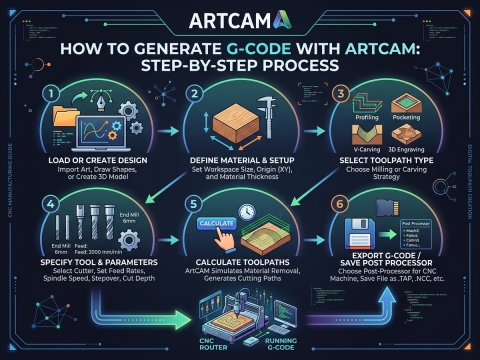
9. Generates Gcode via LazyCam or Wizards.
10. Customizable M-Codes and Macros using VBscript.
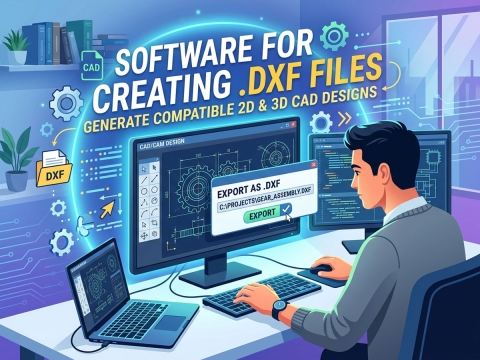
11. Allows direct import of DXF, BMP, JPG, and HPGL files through LazyCam.
12. Converts a standard PC to a fully featured, 6-axis CNC controller.
Mach3 Applications
1. CNC Mill.
2. CNC Router.
3. CNC Lathe Machine.
4. CNC Laser Machine.
5. CNC Plasma Cutter.
How Does Mach3 Work?
Mach3 is a type of CNC software that runs on a PC and turns it into a very powerful and economical machine controller. To run Mach3, you need a PC running the Windows operating system with at least a 1GHz processor with a 1024 x 768 pixel resolution screen. Mach3 and its parallel port driver communicate with the machine hardware through one parallel ports or printer ports. If your computer does not have a parallel port, you can buy a motion controller board from a third-party vendor that uses a USB port or Ethernet for communication. Use of a motion controller board can remove considerable processing load from the computer, so you may want to consider using one to get the performance advantage even if your computer does have a parallel port available. Mach3 generates step pulses and direction signals to perform the steps defined by a GCode part program and sends them to the port or motion controller board. The drivers for your machine's axis motors must accept March3's step pulses and direction signals. Virtually all stepper motor drivers work like this, as do modern DC and AC servo systems with digital encoders. Beware if you are converting an old NC machine whose servos may use resolvers to measure position of the axes as you will have to provide a complete new drive for each axis. To set up a CNC system to use Mach3 software, you must install the Mach3 CNC controller software on your computer, and properly connect your motor drives to the computer's ports.
Mach3 Installation
Computer Operating System Requirements for Parallel Ports.
1. Desktop PC (Laptops are not supported) with at least one parallel port.
2. 32-bit version of Windows 2000, Windows XP, Windows Vista, or Windows 7. (64-bit versions will not be supported)
3. 1Ghz CPU, 512MB RAM.
4. Non-integrated Video Card with 32MB RAM. (Large G-code files, especially 3D files will require a video card with 512MB RAM or higher)
Operating System (OS) Requirements with an External Motion Device.
1. An external motion controller. (USB UC100, or Ethernet Smooth Stepper, etc.)
2. Desktop or Laptop with Windows 2000, Windows XP, Windows Vista, Windows 7, Windows 8 or Windows 10.
3. 1Ghz CPU, 512MB RAM.
4. Video Card with 32MB RAM. (Large G-code files, especially 3D files will require a video card with 512MB RAM or higher)
If you already have an old version of Mach3 installed on your computer, you can install the new version on top of it. You do not need to uninstall the old version first.
1. Turn off the PC, the CNC machine, and its drives.
2. Switch the PC back on.
3. Run the Mach3 CNC software installation package.
When you run the downloaded file, you will be guided through the usual installation steps for a windows program such as accepting the license conditions and selecting the folder for Mach3. STYLECNC recommends that you allow Mach3 to use its default installation folder "C:\Mach3". You will be asked if you want to install various program components, as shown in Figure 1:
4. Select program components screen.
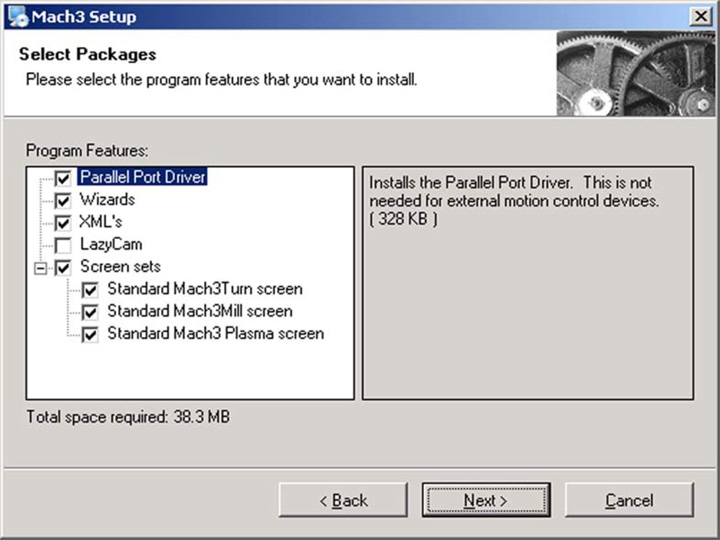
Figure1
When you have selected the components you want, click the Next button. The installation procedure will ask if you want to create a custom profile, as shown in Figure 2:
5. Create a custom profile screen.
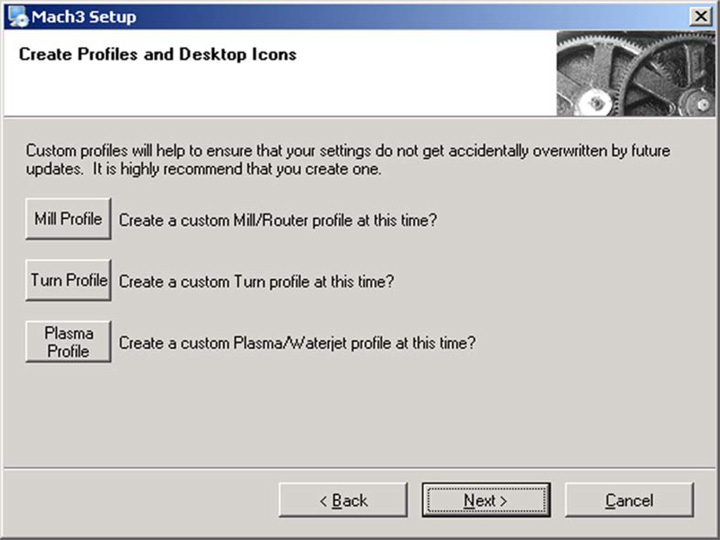
Figure 2
For example, If you click the "Mill Profile" button, the screen shown in Figure 3 appears. Of course, you should choose the right profile button for your CNC machine tool.
6. Create "Mill Profile".
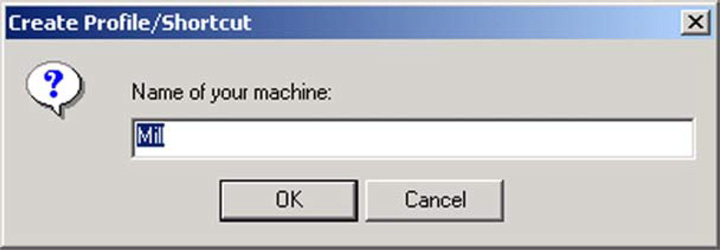
Figure 3
Enter the name you want to assign to the profile and click the "OK" button. If you want, you can create several different profiles. When you have created your custom profile, click the "Next" button.
7. Vital reboot.
You must reboot Windows before running Mach3 software. This reboot is vital. If you do not do it, you will get into great difficulties which can only be overcome by using the "Windows Control Panel" to uninstall the driver manually. So please reboot now.
8. Testing Mach3 installation with your CNC machine.
Up to now, Mach3 CNC controller software is installed, we hope you can enjoy this software with your CNC machine tool.
Motor Tuning Best Practices for Mach3
Incorrect motor tuning is the most common reason new Mach3 users experience stalling, missed steps, or erratic axis movement. The four critical parameters steps per unit, velocity, acceleration, and pulse timing must match your specific hardware configuration. To calculate steps per unit correctly, multiply your stepper motor’s native steps per revolution (typically 200 for a 1.8° motor) by your driver’s microstepping setting, then divide by the linear distance per revolution of your lead screw or the pitch of your rack-and-pinion system. For example, a 200-step motor at 16x microstepping on a 2 mm pitch ball screw yields 1,600 steps per millimeter.
Start with conservative velocity and acceleration values, then increase gradually. If a motor stalls or shudders at higher speeds, the issue is often mechanical loose belts, insufficient driver voltage, or a laptop that cannot deliver stable pulse timing. Run the Mach3 DriverTest utility to verify your PC produces a clean, flat pulse waveform before troubleshooting anything else. Desktops with dedicated parallel ports are far more reliable than laptops for Mach3 control. For detailed hardware compatibility, see the CNC router parts and accessories section to match drivers and breakout boards to your machine.
Common Mach3 Configuration Mistakes to Avoid
Forum discussions across CNCZone and Mach Support consistently highlight the same beginner errors. Unit mismatch is the most frequent: Mach3 defaults to metric, so users who set up their steps-per-unit in inches without changing the native units to imperial will see drastically wrong movements. Always confirm the native units setting under Config > General Configuration before entering any motor tuning values.
Reversed axis direction causes G-code to cut mirror images. Rather than swapping motor wiring, toggle the DirLowActive checkbox in Ports and Pins for the affected axis. Missing kernel frequency adjustment is another overlooked step higher kernel rates (up to 100 kHz on capable PCs) allow smoother motion at fast feed rates, but can overload slower machines. If you encounter stuttering during complex toolpaths, review our 22 common CNC router problems and solutions for additional diagnostic steps.
Which CNC Machines Work Best with Mach3?
Mach3 is most widely used with CNC routers and CNC milling machines, particularly hobby and small-shop setups running stepper motors through parallel-port breakout boards. It also supports plasma cutting profiles with THC integration and lathe operations via its dedicated Mach3Turn interface. However, Mach3 is a legacy platform it requires Windows XP through Windows 7 for optimal parallel-port performance, and Artsoft no longer actively develops new features. Shops evaluating alternatives should compare Mach3 against newer options listed in our CNC programming software guide, including Mach4, UCCNC, and LinuxCNC.
For first-time CNC owners building a hobby CNC router setup, Mach3 remains a solid choice thanks to its large user community, extensive wizard library, and straightforward G-code visualization. The free demo version runs up to 500 lines of G-code and operates in simulation mode without a parallel-port driver, ideal for learning before committing to a licensed copy.
FAQs
Why does Mach3 freeze mid-job without displaying an error message?
Almost always a PC issue, background Windows updates, power-saving modes, or a slow hard drive choking on large G-code files. Disable sleep and Windows Update during operation, and run DriverTest.exe to confirm stable pulse output.
Can Mach3 run on Windows 10 or 11?
Not with the built-in parallel port driver, it only works on 32-bit Windows XP through 7. For Windows 10/11, install an external motion controller like a Warp9 SmoothStepper (Ethernet) or UC100 (USB) that handles pulse generation outside the OS.
My spindle won’t start when I press Cycle Start, What happened?
Usually a missing or corrupted Macros folder. Verify Mach3\Macros\Mach3Mill\ exists and contains your M-code scripts. If the folder was moved or deleted, reinstall Mach3 to a temp directory and copy the Macros folder back.
Why does my G-code cut a mirror image of the design?
One axis has its direction reversed. Toggle DirLowActive in Ports and Pins > Motor Outputs for the affected axis instead of swapping motor wires. Re-jog to confirm positive movement matches your coordinate convention.
Why do my custom M-code Macros work in the VB editor but fail during a program run?
Mach3 saves Macros to the default profile not necessarily the active one. Verify the macro file exists in the correct profile’s Macros subfolder. If using clone profiles for testing, copy macro files manually between directories.
What’s the most stable Mach3 version to install?
Community consensus points to R3.043.062 or R3.043.066 fewest reported bugs with motion controllers and Macros. Always back up your XML profile before upgrading.
My machine stops randomly, but the program keeps running on the screen, why?
This points to a transient electrical fault typically a noisy e-stop switch or loose limit-switch wiring triggering a brief hardware stop without latching in Mach3. Check all switch connections, replace suspect switches, and add shielded cable on input lines.
Can I use a generic USB-to-parallel adapter with Mach3?
No. Generic adapters lack real-time pulse timing. Use a dedicated motion controller (SmoothStepper, UC100) or a PCI parallel port card. Generic adapters appear connected but produce no motor movement.